|
 |
 |
 |
 |
 |
 |
 |
 |
 |

| . |  |
. |
An End To A Dark Mystery That Will Simplify The Universe
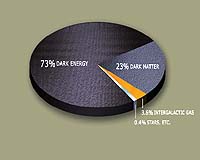
St Andrews, Scotland (SPX) Feb 04, 2008 Astronomers at the University of St Andrews believe they can "simplify the dark side of the universe" by shedding new light on two of its mysterious constituents. Dr HongSheng Zhao, of the University's School of Physics and Astronomy, has shown that the puzzling dark matter and its counterpart dark energy may be more closely linked than was previously thought. Only 4% of the universe is made of known material - the other 96% is traditionally labelled into two sectors, dark matter and dark energy. A British astrophysicist and Advanced Fellow of the UK's Science and Technology Facilities Council, Dr Zhao points out, "Both dark matter and dark energy could be two faces of the same coin. "As astronomers gain understanding of the subtle effects of dark energy in galaxies in the future, we will solve the mystery of astronomical dark matter at the same time. " Astronomers believe that both the universe and galaxies are held together by the gravitational attraction of a huge amount of unseen material, first noted by the Swiss astronomer Fritz Zwicky in 1933, and now commonly referred to as dark matter. Dr Zhao reports that, "Dark energy has already revealed its presence by masking as dark matter 60 years ago if we accept that dark matter and dark energy are linked phenomena that share a common origin." In Dr Zhao's model, dark energy and dark matter are simply different manifestations of the same thing, which he has considered as a 'dark fluid'. On the scale of galaxies, this dark fluid behaves like matter and on the scale of the Universe overall as dark energy, driving the expansion of the Universe. Importantly, his model, unlike some similar work, is detailed enough to produce the same 3:1 ratio of dark energy to dark matter as is predicted by cosmologists. Efforts are currently underway to hunt for very massive dark-matter particles with a variety of experiments. The Large Hadron Collider (LHC) at the European Organization for Nuclear Research (CERN) in Geneva is a particle accelerator that amongst other objectives, could potentially detect dark matter particles. According to Dr Zhao, these efforts could turn out to be fruitless. He said, "In this simpler picture of universe, the dark matter would be at a surprisingly low energy scale, too low to be probed by upcoming Large Hadron Collider. "The search for dark-matter particles so far has concentrated on highly-energetic particles. If dark matter however is a twin phenomenon of dark energy, it will not show up at instruments like the LHC, but has been seen over and over again in galaxies by astronomers." However, the Universe might be absent of dark-matter particles at all. The findings of Dr Zhao are also compatible with an interpretation of the dark component as a modification of the law of gravity rather than particles or energy. Dr Zhao concluded. "No matter what dark matter and dark energy are, these two phenomena are likely not independent of each other." Community Email This Article Comment On This Article Related Links Science and Technology Facilities Council Understanding Time and Space
 Possible Cosmic Defect May Be A Window Into The Early Universe
 Washington DC (SPX) Oct 29, 2007
An unusual cold spot in the oldest radiation in the universe, the cosmic microwave background, may be caused by a cosmic defect created just after the Big Bang, a Spanish and U.K. research team has found. Although these findings need confirmation with further research, the suggestion may provide cosmologists with a long-sought clue about how the infant universe evolved. |
|
|

| The content herein, unless otherwise known to be public domain, are Copyright 1995-2007 - SpaceDaily.AFP and UPI Wire Stories are copyright Agence France-Presse and United Press International. ESA Portal Reports are copyright European Space Agency. All NASA sourced material is public domain. Additional copyrights may apply in whole or part to other bona fide parties. Advertising does not imply endorsement,agreement or approval of any opinions, statements or information provided by SpaceDaily on any Web page published or hosted by SpaceDaily. Privacy Statement |