 |
 |
 |
 |
 |
 |
 |
 |
 |
 |

| . |  |
. |
An X-ray Transit Of Mercury
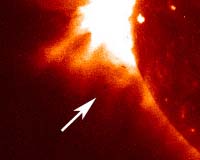
Huntsville AL (SPX) Nov 19, 2006 To appreciate the majesty and power of a typical G-type star, you need only glance at this photo: The tiny black speck is Mercury. The star looming in the background is our own sun. The Japanese Space Agency's new orbiting solar observatory, Hinode (formerly known as Solar B), took the picture on Nov. 8th just as Mercury was about to begin a rare solar transit. Thousands of people on Earth saw and photographed the event, but Hinode's photo is like no other because it shows the view through an X-ray telescope. "Hinode's X-ray telescope, the XRT, is the best solar X-ray telescope ever flown," says John Davis, NASA's Hinode project scientist at the Marshall Space Flight Center. "The XRT has arc-second resolution and can take pictures as rapidly as once every second." X-rays interest solar physicists because they reveal the hottest gases in the sun's atmosphere. The bright flourish just above Mercury, for instance, is a gigantic mass of million-degree plasma trapped in the magnetic field of a sunspot. Viewed through an ordinary white light telescope, that hot mass would be almost completely invisible. Truly, "these are unique images," says Davis. When the transit began, that is, when Mercury moved directly in front of the sun's surface, Hinode zoomed in using another of its telescopes, the SOT (Solar Optical Telescope). The images reveal Mercury as no mere speck but a full-fledged planetary disk: Viewing the movie, Davis points out "the motions in the background." The sun's surface boils like water atop a hot stove. Each of the bubbling "granules" is about the size of a terrestrial continent. Hinode, just launched in September, is still in the shake-down phase of its mission. Ground controllers are testing Hinode's telescopes and other systems and don't expect to begin routine science operations until next month. The transit of Mercury is just a hint of what's to come. Related Links JAXA News Flash at Mercury  Hinode Captures Mercury Transit
 Tokyo, Japan (SPX) Nov 15, 2006
The Solar Optical Telescope on Hinode has captured sequential images of Mercury passing directly in front of the sun. Known as a Mercury transit, the event occurred Nov. 8, for the first time since 2003. Mercury transits are relatively rare, with only about 13 occurring each century. The solar image shows the granulation pattern that is the visible surface of the sun's convection zone. |
|
|

| The content herein, unless otherwise known to be public domain, are Copyright 1995-2006 - SpaceDaily.AFP and UPI Wire Stories are copyright Agence France-Presse and United Press International. ESA PortalReports are copyright European Space Agency. All NASA sourced material is public domain. Additionalcopyrights may apply in whole or part to other bona fide parties. Advertising does not imply endorsement,agreement or approval of any opinions, statements or information provided by SpaceDaily on any Web page published or hosted by SpaceDaily. Privacy Statement |