|
 |
 |
 |
 |
 |
 |
 |
 |
 |

| . |  |
. |
Hinode Captures Mercury Transit
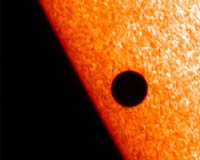
Tokyo, Japan (SPX) Nov 15, 2006 The Solar Optical Telescope on Hinode has captured sequential images of Mercury passing directly in front of the sun. Known as a Mercury transit, the event occurred Nov. 8, for the first time since 2003. Mercury transits are relatively rare, with only about 13 occurring each century. The solar image shows the granulation pattern that is the visible surface of the sun's convection zone. Known as Solar-B before reaching orbit, Hinode seeks to shed new light on the sun's magnetic field and how it impacts life on Earth. Led by the Japan Aerospace Exploration Agency, the mission is a collaboration between the space agencies of Japan, the United States, the United Kingdom and Europe. Related Links Japan Aerospace Exploration Agency News Flash at Mercury Stellar Chemistry, The Universe And All Within It  Upcoming Mercury Transit Whets The Appetite For MESSENGER
 Laurel MD (SPX) Nov 07, 2006
On Wednesday, November 8, the planet Mercury will make a rare trek across the face of the Sun, beginning at 2:12 p.m. EST and lasting for nearly five hours. Observers in North and South America, Australia, and parts of Asia will have a good view; the transit also will be captured via a live Webcast that will include discussions on the science, technology, and history of the transit, as well as current knowledge of the Sun and space weather. |
|
|

| The content herein, unless otherwise known to be public domain, are Copyright 1995-2006 - SpaceDaily.AFP and UPI Wire Stories are copyright Agence France-Presse and United Press International. ESA PortalReports are copyright European Space Agency. All NASA sourced material is public domain. Additionalcopyrights may apply in whole or part to other bona fide parties. Advertising does not imply endorsement,agreement or approval of any opinions, statements or information provided by SpaceDaily on any Web page published or hosted by SpaceDaily. Privacy Statement |