|
 |
 |
 |
 |
 |
 |
 |
 |
 |

| . |  |
. |
Analysis: Afghanistan meets U.S. vote
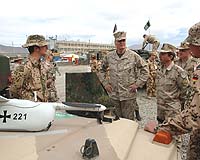
Berlin (UPI) Feb 7, 2008 The German government fears a Democratic U.S. president will increase the pressure on Germany to send more troops into Afghanistan. The U.S. Democrats have in the past announced they would cooperate more closely with the Europeans in the Middle East, but also demand more from them, Karsten Voigt, the German government's coordinator for American relations, said in a radio interview. "The Americans want Europe to do more (in Afghanistan) when it comes to military matters, the rebuilding of the police and civic reconstruction," Voigt told German public radio WDR 5. On Wednesday, German Defense Minister Franz Josef Jung reiterated his decision that Germany's focus will remain in the northern provinces of Afghanistan, where the Germans command some 4,000 soldiers from 19 nations (including more than 3,000 German troops), but added that in an emergency, German troops would help NATO allies all over the country. Jung also announced that Germany had agreed to a NATO request to replace a Norwegian quick-reaction force that will leave Afghanistan in July. Berlin agreed to send some 200 troops because it is "militarily necessary," Jung said. "We are on a successful course in Afghanistan and we must not leave a void." Jung said the quick-reaction force would be available for support missions all over Afghanistan, including the volatile south, but added such missions would require his explicit approval. This is in line with the German parliamentary mandate for Afghanistan, he said. That mandate confines German troops to reconstruction efforts in the relatively peaceful northern provinces (except for emergency help). What irks NATO officials most is the German unwillingness to send troops to join the fighting in the volatile southern and eastern provinces of the country. There, the International Security Assistance Force and the U.S.-led Operation Enduring Freedom engage in bloody conflicts with Taliban rebels. Last week Jung turned down an unusually direct U.S. request to send his troops permanently into the volatile southern and eastern provinces. U.S. Defense Secretary Robert Gates had written a letter to all NATO states (including Germany), asking them to deploy more troops to southern Afghanistan. Gates' eight-page letter called for additional German soldiers and military equipment, such as helicopters, German daily Sueddeutsche Zeitung reported. Gates informed his German counterpart that Washington would send an additional 3,200 troops into Afghanistan (some 26,000 U.S. soldiers are already on the ground). After seven months, Gates wrote Jung, Germany and other NATO members would have to replace those troops. While Germany's Frankfurter Allgemeine Zeitung daily Wednesday said the letter may have been written without President Bush's and U.S. Secretary of State Condoleezza Rice's knowledge, it nevertheless increased the pressure on European NATO members to do more in Afghanistan. Canada also followed up with its own request: Either European NATO members would live up to their alliance responsibilities and send 1,000 troops and helicopters, or Canada in 2009 will pull out completely its 2,500 soldiers from Afghanistan. Jung said Wednesday it would be a mistake to shift Germany's focus away from the north, as the terror threat was increasing there, and the successful work Germany has done there should not be endangered. "We have nearly 4,000 troops for a region half the size of Germany," Jung said, adding that in personal conversations with several NATO allies, including Gates and his Canadian counterpart Peter MacKay, no official had voiced a desire for German troops to venture south. NATO's comprehensive approach, which Jung said includes "protecting, helping, mediating and fighting," was the best way to handle the situation on the ground. The German defense minister added he is missing reports of the positives in Afghanistan, citing tripled incomes, a growth in women students, and 9,000 schools that have been built over the past years. However, the terror threat is still alive in Afghanistan, and it seems the previously quiet northern provinces will have to be ready to take on further heat. Germany will step up security around the city of Kunduz to answer "heightened security threats," Jung said Wednesday. In the final four months of 2007, some 36 rocket attacks targeted Western soldiers in a two- to four-mile radius around Kunduz, with one piercing through the cafeteria of a German military camp -- luckily, the device didn't explode. Jung said Germany would also step up the training of Afghan police, adding that some 195 police trainers from all over Europe, including 60 from Germany, will be in northern Afghanistan by March. And as for the overall outlook, that is painted too gloomy in the media, Jung said. "Our soldiers are well-equipped and highly motivated," he said. "We are on a good course in Afghanistan." Community Email This Article Comment On This Article Related Links News From Across The Stans
 Turkish air raid hits Kurdish rebel bases in Iraq: army
 Ankara (AFP) Feb 7, 2008
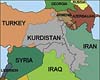
Turkish fighter planes have successfully hit about 70 Kurdish rebel positions targeted in an air strike in northern Iraq earlier this week, the Turkish army said Thursday. |
|
|

| The content herein, unless otherwise known to be public domain, are Copyright 1995-2007 - SpaceDaily.AFP and UPI Wire Stories are copyright Agence France-Presse and United Press International. ESA Portal Reports are copyright European Space Agency. All NASA sourced material is public domain. Additional copyrights may apply in whole or part to other bona fide parties. Advertising does not imply endorsement,agreement or approval of any opinions, statements or information provided by SpaceDaily on any Web page published or hosted by SpaceDaily. Privacy Statement |