|
 |
 |
 |
 |
 |
 |
 |
 |
 |

| . |  |
. |
Area Responsible For Self-Control Found In The Human Brain
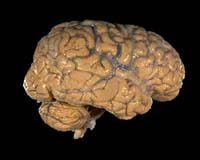
Washington DC (SPX) Aug 22, 2007 The area of the brain responsible for self-control-where the decision not to do something occurs after thinking about doing it-is separate from the area associated with taking action, scientists say in the August 22 issue of The Journal of Neuroscience. "The results illuminate a very important aspect of the brain's control of behavior, the ability to hold off doing something after you've developed the intention to do it-one might call it 'free won't' as opposed to free will," says Martha Farah, PhD, of the University of Pennsylvania. "It is very important to identify the circuits that enable 'free won't' because of the many psychiatric disorders for which self-control problems figure prominently-from attention deficit disorder to substance dependence and various personality disorders." Farah was not involved in the experiment. The findings broaden understanding of the neural basis for decision making, or free will, and may help explain why some individuals are impulsive while others are reluctant to act, says lead author Marcel Brass, PhD, of the Max Planck Institute for Human Cognitive and Brain Sciences and Ghent University. Brass and Patrick Haggard, PhD, of University College London, used functional magnetic resonance imaging (fMRI) to study the brain activity of participants pressing a button at times they chose themselves. They compared data from these trials to results when the participants prepared to hit the button, then decided to hold back or veto the action. Fifteen right-handed participants were asked to press a button on a keyboard. They were asked to choose some cases in which they stopped just before pressing the button. Participants also indicated on a clock the time at which they intended to press the button or decided to hold back. When Brass and Haggard compared fMRI images of the two scenarios, they found that pulling back yielded activity in the dorsal fronto-median cortex (dFMC), an area on the midline of the brain directly above the eyes, which did not show up when participants followed through and made the action. In addition, those who chose to stop the intended action most often showed greatest contrast in dFMC activity. "The capacity to withhold an action that we have prepared but reconsidered is an important distinction between intelligent and impulsive behavior," says Brass, "and also between humans and other animals." Future study will involve methods with a better time resolution such as EEG to determine whether the inhibitory process could operate in the brief time period between the time of conscious intention and the point of no return for motor output. The work was supported by the German Research Foundation. Community Email This Article Comment On This Article Related Links Society for Neuroscience All About Human Beings and How We Got To Be Here
 Milestone In The Regeneration Of Brain Cells: Supportive Cells Generate New Nerve Cells
 Neuherberg, Germany (SPX) Aug 21, 2007
The research group of Prof. Dr. Magdalena Gotz at the Institute of Stem Cell Research of the GSF - National Research Centre for Environment and Health, and the Ludwig Maximilians University, Munich, has achieved an additional step for the potential replacement of damaged brain cells after injury or disease: functional nerve cells can be generated from astroglia, a type of supportive cells in the brain by means of special regulator proteins. |
|
|

| The content herein, unless otherwise known to be public domain, are Copyright 1995-2007 - SpaceDaily.AFP and UPI Wire Stories are copyright Agence France-Presse and United Press International. ESA Portal Reports are copyright European Space Agency. All NASA sourced material is public domain. Additional copyrights may apply in whole or part to other bona fide parties. Advertising does not imply endorsement,agreement or approval of any opinions, statements or information provided by SpaceDaily on any Web page published or hosted by SpaceDaily. Privacy Statement |