|
 |
 |
 |
 |
 |
 |
 |
 |
 |

| . |  |
. |
Astronomers Measure Mass Of Smallest Black Hole In A Galactic Nucleus
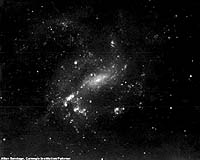
Washington DC (SPX) Feb 21, 2005 A group led by astronomers from Ohio State University and the Technion-Israel Institute of Technology have measured the mass of a unique black hole, and determined that it is the smallest found so far. Early results indicate that the black hole weighs in at less than a million times the mass of our sun -� which would make it as much as 100 times smaller than others of its type. To get their measurement, astronomers used NASA's Hubble Space Telescope and a technique similar to Doppler radar -- the method that meteorologists use to track weather systems. The black hole lies 14 million light-years away, in the center of the galaxy NGC 4395. One light-year is the distance light travels in one year -- approximately six trillion miles. Astronomers consider NGC 4395 to be an "active galaxy," one with a very bright center, or nucleus. Current theory holds that black holes may literally be consuming active galactic nuclei (AGNs). Black holes in AGNs are supposed to be very massive. NGC 4395 appears to be special, because the black hole in the center of the galaxy is much smaller than those found in other active galaxies, explained Ari Laor, professor of astronomy at the Technion, in Haifa, Israel, and Brad Peterson, professor of astronomy at Ohio State. While astronomers have found much evidence of black holes that are larger than a million solar masses or smaller than a few tens of solar masses, they haven't found as many midsize black holes -- ones on the scale of hundreds or thousands of solar masses. Black holes such as the one in NGC 4395 provide a step in closing that gap. Laor and Peterson and their colleagues used the Doppler radar-like technique to track the movement of gas around the center of NGC 4395. Whereas radar bounces a radio frequency signal off of an object, the astronomers observed light signals that naturally emanated from the center of the galaxy, and timed how long those signals took to reach the orbiting gas. The method is called reverberation mapping, and Peterson's team is among a small number of groups who are developing it as a reliable means of measuring black hole masses. The method works because gas orbits faster around massive black holes than it does around smaller ones. Peterson reported the early results Saturday at the meeting of the American Association for the Advancement of Science in Washington, DC. Two of the team members -- Luis Ho of the Observatories of the Carnegie Institution of Washington, and Alex Fillippenko of the University of California, Berkeley -- were the first to suspect that the black hole mass was very small. Filippenko and Wallace L.W. Sargent of the California Institute of Technology first discovered the black hole in 1989. This is the first time astronomers have been able to measure the mass of the black hole in NGC 4395, and confirm that it is indeed smaller than others of its kind. Peterson and Laor emphasized that the results are very preliminary, but the black hole seems to be at least a hundred times smaller than any other black hole ever detected inside an AGN. The astronomers want to refine that estimate before they address the next most logical question: why is the black hole so small? "Is it the runt of the litter, or did it just happen to form under special circumstances? We don't know yet," Peterson said. NGC 4395 doesn't appear to have a dense spherical nucleus, called a galactic bulge, at its center; it could be that the black hole "ate" all the stars in the bulge, and doesn't have any more food within reach. That would keep the black hole from growing. Team members are most interested in what the black hole measurement can tell astronomers about AGNs in general. Any new information could help astronomers better understand the role that black holes play in making galaxies like our own form and evolve. To that end, the team is also studying related data from NASA's Chandra X-ray Observatory and ground-based telescopes. "It's these extreme types of objects that really allow you to test your theories," Peterson said. Related Links Ohio State University SpaceDaily Search SpaceDaily Subscribe To SpaceDaily Express  NASA Observatory Confirms Black Hole Limits
 Washington DC (SPX) Feb 16, 2005
The very largest black holes reach a certain point and then grow no more. That's according to the best survey to date of black holes made with NASA's Chandra X-ray Observatory. |
|
|

| The content herein, unless otherwise known to be public domain, are Copyright 1995-2006 - SpaceDaily.AFP and UPI Wire Stories are copyright Agence France-Presse and United Press International. ESA PortalReports are copyright European Space Agency. All NASA sourced material is public domain. Additionalcopyrights may apply in whole or part to other bona fide parties. Advertising does not imply endorsement,agreement or approval of any opinions, statements or information provided by SpaceDaily on any Web page published or hosted by SpaceDaily. Privacy Statement |