 |
 |
 |
 |
 |
 |
 |
 |
 |
 |

| . |  |
. |
Astronomers Weigh Adopted Twin Brown Dwarfs
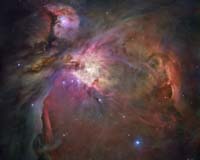
SpaceDaily US Editor Washington DC (SPX) Mar 16, 2006 Astronomers for the first time have precisely measured the mass of a pair of elusive brown dwarfs, and the data from the twin objects - not quite big enough to be stars, but too large to be planets � match well with theoretical predictions. "These two brown dwarfs provide the first translation between their masses and their other physical properties," team leader Keivan Stassun of Vanderbilt University in Nashville, Tenn., told SpaceDaily.com. He said the binary pair represents a "Rosetta Stone" that will "help unlock many of the mysteries" surrounding these objects. Stassun and colleagues from the University of Wisconsin in Madison, and the Space Telescope Science Institute in Baltimore, found the pair locked in a tight orbit around a mutual gravitational center almost perfectly edge-on to Earth-based telescopes. Brown dwarfs are hot luminous objects, but they are smaller and dimmer than Sun-sized stars, so only recently have astronomers been able to detect any potential candidates. The critical piece of missing information, however, has been their masses, because mass is destiny for stars and star-like objects. In this case, direct measurements of the twins fell well within the anticipated range for brown dwarfs: from 13 to 80 times the mass of Jupiter. Much larger and their internal gravity would have been strong enough to initiate nuclear fusion, and they would have ignited as full-blown stars. Smaller and they would have become gas giants, such as Jupiter and Saturn. Analyzing about 1,500 images collected over 300 observing nights over 12 years, the trio carefully tracked periodic dips in the pair's combined luminosity and Doppler shifts to determine one brown dwarf has 55 times Jupiter's mass and the other 35 times Jupiter's. "The margin of error is only 10 percent, so they are clearly brown dwarfs," Stassun said. "It's Physics 101." Reporting in the March 16 issue of the journal Nature, the team said the data show both dwarfs are remarkably large for their masses: about the same diameter as the Sun. Because the pair is located in a star-forming region in the Orion nebula, they also must be very young � perhaps only a million years old. Their ages and large size support a hypothesis that brown dwarfs begin life in nearly star-like states, but then contract and cool slowly over their very long lifetimes. "We understand how stars form in the crudest sense," Stassun said. "They are formed when clouds of dust and gas collapse, but many of the details of the process remain a mystery, particularly the factors that determine what a star will weigh." Maybe the most striking aspect of the discovery by Stassun and his collaborators, Robert Mathieu at the University of Wisconsin in Madison and astronomer Jeff Valenti of the Space Telescope Science Institute in Baltimore, was the pair of brown dwarfs orbit each other around an axis oriented at 88.9 degrees, or nearly perpendicular to the line of sight to Earth � and perfect for this type of data gathering. The pair orbits each other so closely they appear as a single object through telescopes. Because of their special orientation, the two objects periodically eclipse each other, and the eclipses cause regular dips in the brightness of the light coming from their joint image. By timing these occultations precisely the astronomers determined the orbits of the two objects. Applying Newtonian principles to the information enabled Stassun's team to calculate each dwarf's mass. Carefully measuring the light spectrum coming from the pair enabled the researchers to determine their surface temperatures. Theory predicts the more massive of the two should be hotter, but the team found just the opposite: The heavier dwarf shows a temperature of 2,650 degrees Kelvin (4,310 degrees Fahrenheit), while the lighter one is 2,790 degrees K (4,562 degrees F). The Sun is 5,900 degrees K (9,980 degrees F) at its surface. "One possible explanation is that the two objects have different origins and ages," Stassun explained � meaning they are adopted twins, not fraternal. That would support recent computer simulations predicting many brown dwarfs are created so close together they likely disrupt one another's formation. "Their finding that the more massive object is cooler is very surprising, and indicative of the remaining gaps in our knowledge of these objects," Subhanjoy Mohanty of the Harvard-Smithsonian Center for Astrophysics in Cambridge, Mass., told SpaceDaily.com. "While I do not think the temperature reversal signifies a fundamental breakdown of the evolutionary models, it does point to physical processes ... that must be incorporated in the evolutionary models for a complete understanding of low-mass stars, brown dwarfs and giant planets." Stassun said the finding suggests brown dwarfs might be the most common product of star formation, and therefore "information on the number and the size distribution of these objects can provide us with a lot of valuable information about the details of this process." The new information also gives astronomers data points they can plot on a key graph called the mass-luminosity relationship. This is a curve that tracks the mass and brightness of many different types and sizes of stars. The curve consistently shows that stars of the same type and brightness tend to have similar masses. The new brown dwarf figures will help to solidify the lower end of the curve, allowing astronomers to determine the masses of similar faint objects with greater accuracy. Related Links Brown Dwarf Research  Deriving The Shape Of The Galactic Stellar Disc
 Padua, Italy (SPX) Mar 17, 2006
While analysing the complex structure of the Milky Way, an international team of astronomers from Italy and the United Kingdom has recently derived the shape of the Galactic outer stellar disc, and provided the strongest evidence that, besides being warped, it is at least 70% more extended than previously thought. |
|
|

| The content herein, unless otherwise known to be public domain, are Copyright 1995-2006 - SpaceDaily.AFP and UPI Wire Stories are copyright Agence France-Presse and United Press International. ESA PortalReports are copyright European Space Agency. All NASA sourced material is public domain. Additionalcopyrights may apply in whole or part to other bona fide parties. Advertising does not imply endorsement,agreement or approval of any opinions, statements or information provided by SpaceDaily on any Web page published or hosted by SpaceDaily. Privacy Statement |