|
 |
 |
 |
 |
 |
 |
 |
 |
 |

| . |  |
. |
Deriving The Shape Of The Galactic Stellar Disc
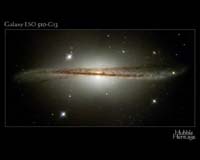
Padua, Italy (SPX) Mar 17, 2006 While analysing the complex structure of the Milky Way, an international team of astronomers from Italy and the United Kingdom has recently derived the shape of the Galactic outer stellar disc, and provided the strongest evidence that, besides being warped, it is at least 70% more extended than previously thought. Their findings will be reported in an upcoming issue of Astronomy & Astrophysics, and is a new step in understanding the large-scale structure of our Galaxy.
Using the 2MASS all-sky near infrared catalogue, Yazan Momany and his collaborators reconstructed the outer structure of the Galactic stellar disc, in particular, its warp. Their work will soon be published in Astronomy & Astrophysics. Observationally, the warp is a bending of the Galactic plane upwards in the first and second Galactic longitude quadrants (0
The disc of our Galaxy is made up of three major components: the stellar, the gaseous, and the interstellar dust components. The warping of the gas and dust component has been well established and documented. In particular, the gaseous component is known to be warped and to extend out to 25,000 parsecs (pc). In contrast, the true extent of this stellar warping is still being debated. Over the past years, there has been changing evidence of a difference in the warp amplitude between stars and gas. These studies have led to the idea that the Milky Way stellar disc is truncated beyond 14,000 pc from the Galactic centre.
The new analysis by Momany and his team provides the first clear and complete view of the outer stellar disc warp. They analyzed the distribution of over 115 million stars from the all-sky 2MASS catalogue that comprise the totality of the Galactic disc. Among the many different stellar types, M-giant stars were found to be the ideal stellar tracer for reconstructing the outer disc structure.
They are, in fact, highly luminous but relatively cool and evolved stars, and these unique properties allow better determination of their distance. The analysis also shows that M-giants stars located at distances between 3,000 and of 17,000 pc from the Sun draw the same stellar warp signature. This means that a global and large-scale Milky Way feature has been identified to about 25,000 pc from the Galactic centre: the team thus clearly demonstrates that there is no truncation of the stellar disc beyond 14,000 pc.
Last but not least, this new evidence of an extended and warped Milky Way stellar disc allows the team to solve a heated debate among astronomers. In the past years, astronomers have identified over-densities in the opposite direction to the Galactic centre. Located in the Galactic plane, they stretch over 100 degrees in Monoceros constellation.
Known as the Monoceros Ring, this over-density was believed to be the remnant of a dwarf satellite galaxy cannibalised by the Milky Way. Another well-known example exists in the Sagittarius constellation of how the Milky Way halo is continuously building up by means of cannibalised smaller galaxies. Recently, an over-density located in Canis Major was associated to the Monoceros Ring and identified as the core of a satellite galaxy currently being accreted into the Galactic plane.
Momany and colleagues' work, however, casts serious doubt on this scenario. They show that the Canis Major over-density is easily explained by the imprint of the Galactic warp. They may also be able to explain the Monoceros Ring by the complex structure of the outer disc, but they cannot offer a definite conclusion about this issue yet, as very little is known about the Monoceros Ring. It seems, however, that the Sagittarius dwarf remains the only example we have for the moment of how our Milky Way is still growing by cannibalising smaller galaxies.
[1] The team includes Y. Momany, S. Zaggia, G.P. Piotto (Italy), G. Gilmore, F. De Angeli (United Kingdom), G. Carraro (Chile) and L. Bedin (Germany).
Astronomy & Astrophysics  Astronomers Weigh Adopted Twin Brown Dwarfs
 Washington DC (SPX) Mar 16, 2006
Astronomers for the first time have precisely measured the mass of a pair of elusive brown dwarfs, and the data from the twin objects - not quite big enough to be stars, but too large to be planets � match well with theoretical predictions. |
|
|

| The content herein, unless otherwise known to be public domain, are Copyright 1995-2006 - SpaceDaily.AFP and UPI Wire Stories are copyright Agence France-Presse and United Press International. ESA PortalReports are copyright European Space Agency. All NASA sourced material is public domain. Additionalcopyrights may apply in whole or part to other bona fide parties. Advertising does not imply endorsement,agreement or approval of any opinions, statements or information provided by SpaceDaily on any Web page published or hosted by SpaceDaily. Privacy Statement |