|
 |
 |
 |
 |
 |
 |
 |
 |
 |

| . |  |
. |
Birds Bats And Insects Hold Secrets For Aerospace Engineers
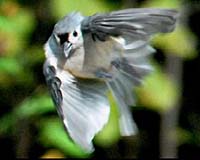
Ann Arbor MI (SPX) Feb 06, 2008 Natural flyers like birds, bats and insects outperform man-made aircraft in aerobatics and efficiency. University of Michigan engineers are studying these animals as a step toward designing flapping-wing planes with wingspans smaller than a deck of playing cards. A Blackbird jet flying nearly 2,000 miles per hour covers 32 body lengths per second. But a common pigeon flying at 50 miles per hour covers 75. The roll rate of the aerobatic A-4 Skyhawk plane is about 720 degrees per second. The roll rate of a barn swallow exceeds 5,000 degrees per second. Select military aircraft can withstand gravitational forces of 8-10 G. Many birds routinely experience positive G-forces greater than 10 G and up to 14 G. "Natural flyers obviously have some highly varied mechanical properties that we really have not incorporated in engineering," said Wei Shyy, chair of the Aerospace Engineering department and an author of the new book "The Aerodynamics of Low Reynolds Number Flyers." "They're not only lighter, but also have much more adaptive structures as well as capabilities of integrating aerodynamics with wing and body shapes, which change all the time," Shyy said. "Natural flyers have outstanding capabilities to remain airborne through wind gusts, rain, and snow." Shyy photographs birds to help him understand their aerodynamics. Pressure generated during flight cause the flapping wings to deform, he explained. In turn, the deformed wing tells the air that the wing shape is different than it appears in still air. If appropriately handled, this phenomenon can delay stall, enhance stability and increase thrust. Flapping flight is inherently unsteady, but that's why it works so well. Birds, bats and insects fly in a messy environment full of gusts traveling at speeds similar to their own. Yet they can react almost instantaneously and adapt with their flexible wings. Shyy and his colleagues have several grants from the Air Force totaling more than $1 million a year to research small flapping wing aircraft. Such aircraft would fly slower than their fixed wing counterparts, and more importantly, they would be able to hover and possibly perch in order to monitor the environment or a hostile area. Shyy's current focus is on the aerodynamics of flexible wings related to micro air vehicles with wingspans between 1 and 3 inches. "These days, if you want to design a flapping wing vehicle, you could build one with trial and error, but in a controlled environment with no wind gusts," Shyy said. "We are trying to figure out how to design a vehicle that can perform a mission in an uncertain environment. When the wind blows, how do they stay on course?" A dragonfly, Shyy says, has remarkable resilience to wind, considering how light it is. The professor chalks that up to its wing structure and flight control. But the details are still questions. "We're really just at the beginning of this," Shyy said. Shyy is the Clarence L. "Kelly" Johnson Collegiate Professor of Aerospace Engineering. Other authors of the book, "Aerodynamics of Low Reynolds Number Flyers" are: U-M research scientists Yongsheng Lian, Jian Tang and Dragos Viieru, and Hao Liu, professor of Biomechanical Engineering at Chiba University in Japan. Other collaborators on this research include professors Luis Bernal, Carlos Cesnik and Peretz Friedmann of the University of Michigan; Hao Liu of Chiba University in Japan; Peter Ifju, Rick Lind and Larry Ukeiley of University of Florida, and Sean Humbert of University of Maryland. Community Email This Article Comment On This Article Related Links University of Michigan Aerospace News at SpaceMart.com
 Flapping-wing airplanes are envisioned
 Ann Arbor, Mich. (UPI) Feb 5, 2008
 U.S. scientists are studying birds, bats and insects and their aerobatic efficiencies as a step toward designing flapping-wing airplanes. |
|
|

| The content herein, unless otherwise known to be public domain, are Copyright 1995-2007 - SpaceDaily.AFP and UPI Wire Stories are copyright Agence France-Presse and United Press International. ESA Portal Reports are copyright European Space Agency. All NASA sourced material is public domain. Additional copyrights may apply in whole or part to other bona fide parties. Advertising does not imply endorsement,agreement or approval of any opinions, statements or information provided by SpaceDaily on any Web page published or hosted by SpaceDaily. Privacy Statement |