 |
 |
 |
 |
 |
 |
 |
 |
 |
 |

| . |  |
. |
Cassini Sinks The Claws Into Saturn Rings And Finds The Lumps
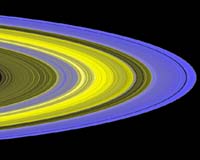
Pasadena CA (JPL) May 23, 2007 Saturn's largest and most densely packed ring is composed of dense clumps of particles separated by nearly empty gaps, according to new findings from NASA's Cassini spacecraft. These clumps in Saturn's B ring are neatly organized and constantly colliding, which surprised scientists. Previous interpretations assumed the ring particles were distributed uniformly and so scientists underestimated the total mass of Saturn's rings. The mass may actually be two or more times previous estimates. "These results will help us understand the overall question of the age and hence the origin of Saturn's rings," said Josh Colwell, assistant professor of physics at the University of Central Florida and a member of the Cassini ultraviolet imaging spectrograph team publishing its results in the journal Icarus this month. Principal investigator Larry Esposito at the University of Colorado, Boulder is fascinated with the findings. "The rings are different from the picture we had in our minds," Esposito said. "We originally thought we would see a uniform cloud of particles. Instead we find that the particles are clumped together with empty spaces in between. If you were flying under Saturn's rings in an airplane, you would see these flashes of sunlight come through the gaps, followed by dark and so forth. This is different from flying under a uniform cloud of particles." The observations were made using the spectrograph aboard the Cassini spacecraft, which left earth in 1997 on a mission to collect detailed data about Saturn, its rings and moons. Cassini -- the largest interplanetary spacecraft launched from earth -- entered Saturn's orbit in July 2004, and scientists have been using sophisticated equipment on board to view and analyze images. Boulder and UCF scientists observed the brightness of a star as the rings passed in front of the star on multiple occasions. This provides a measurement of the amount of ring material between the spacecraft and the star. "Combining many of these occultations at different viewing geometries is like doing a CAT scan of the rings," said Colwell. "By studying the brightness of stars as the rings pass in front of them, we are able to map the ring structure in 3-D and learn more about the shape, spacing and orientation of clusters of particles." The observations confirm that the gravitational attraction of ring particles to each other creates clumps, or "self-gravity wakes." If the clumps were farther from Saturn, they might continue to grow into a moon. But because these clumps are so close to Saturn, their different speeds around Saturn counteract this gravitational attraction so that the clumps get stretched like taffy and pulled apart. The clumps are constantly forming and coming apart once they get to be about 30 to 50 meters (about 100 to 150 feet) across. "At any given time, most particles are going to be in one of the clumps, but the particles keep moving from clump to clump as clumps are destroyed and new ones are formed," added Colwell. Colwell is a professor in UCF's growing program in planetary sciences. He joined the faculty because of the "opportunity to be involved in growing a new planetary sciences program." He is a DeLand native and earned his bachelor's degree at Stetson University before doing advanced study at the University of Colorado, where he met Esposito. Colwell's area of expertise is planetary dynamics and his research focus is determining the origins of the solar system. Email This Article
Related Links  Pasadena CA (SPX) May 17, 2007
Rubbing your hands together on a cold day generates a bit of heat, and the same process of frictional heating may be what powers the geysers jetting out from the surface of Saturn's moon Enceladus. Tidal forces acting on fault lines in the moon's icy shell cause the sides of the faults to rub back and forth against each other, producing enough heat to transform some of the ice into plumes of water vapor and ice crystals, according to a new study published in the May 17 issue of the journal Nature. |
|
|

| The content herein, unless otherwise known to be public domain, are Copyright 1995-2006 - SpaceDaily.AFP and UPI Wire Stories are copyright Agence France-Presse and United Press International. ESA PortalReports are copyright European Space Agency. All NASA sourced material is public domain. Additionalcopyrights may apply in whole or part to other bona fide parties. Advertising does not imply endorsement,agreement or approval of any opinions, statements or information provided by SpaceDaily on any Web page published or hosted by SpaceDaily. Privacy Statement |