|
 |
 |
 |
 |
 |
 |
 |
 |
 |

| . |  |
. |
Cassini Skims By Titan At 1,200 Kilometers
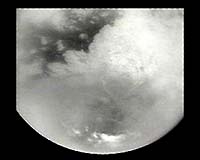
Pasadena CA (SPX) Oct 26, 2004 The Cassini spacecraft beamed back information and pictures today after successfully skimming the hazy atmosphere of Saturn's moon Titan. NASA's Deep Space Network tracking station in Madrid, Spain, acquired a signal at about 6:25 p.m. Pacific Daylight Time (9:25 p.m. Eastern Daylight Time). As anticipated, the spacecraft came within 1,200 kilometers (750 miles) of Titan's surface. At the time, Cassini was about 1.3 billion kilometers (826 million miles) from Earth. Numerous images, perhaps as many as 500, were taken by the visible light camera and were being transmitted back to Earth. It takes 1 hour and 14 minutes for the images to travel from the spacecraft to Earth. The downlink of data will continue through the night into the early morning hours. Cassini project engineers will continue to keep a close watch on a rainstorm in Spain, which may interrupt the flow of data from the spacecraft. The flyby was by far the closest any spacecraft has ever come to Titan, the largest moon of Saturn, perpetually drenched in a thick blanket of smog. Titan is a prime target of the Cassini-Huygens mission because it is the only moon in our solar system with an atmosphere. It is a cosmic time capsule that offers a look back in time to see what Earth might have been like before the appearance of life. The Huygens probe, built and operated by the European Space Agency, is attached to Cassini; its release is planned on Christmas Eve. It will descend through Titan's opaque atmosphere on Jan. 14, 2005, to collect data and touch down on the surface. Related Links SpaceDaily Search SpaceDaily Subscribe To SpaceDaily Express  Cassini Skims By Titan At 1,200 Kilometers
 Washington DC (AFP) Oct 26, 2004
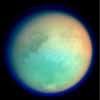
The US-European spacecraft Cassini-Huygens has beamed to Earth the first images of Saturn's moon Titan after a historic flyby skimming its hazy atmosphere, NASA's Jet Propulsion Laboratory in California announced. |
|
|

| The content herein, unless otherwise known to be public domain, are Copyright 1995-2006 - SpaceDaily.AFP and UPI Wire Stories are copyright Agence France-Presse and United Press International. ESA PortalReports are copyright European Space Agency. All NASA sourced material is public domain. Additionalcopyrights may apply in whole or part to other bona fide parties. Advertising does not imply endorsement,agreement or approval of any opinions, statements or information provided by SpaceDaily on any Web page published or hosted by SpaceDaily. Privacy Statement |