|
 |
 |
 |
 |
 |
 |
 |
 |
 |

| . |  |
. |
Deep-Water Fishing Wrecking Ireland's Coral Treasures
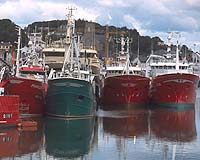
Dublin (AFP) Sep 05 2005 Modern deep-water fishing techniques are seriously damaging huge sections of cold water coral reefs in the Atlantic Ocean off Ireland's west coast, a marine biologist said on Monday. Jason Hall-Spencer, from the University of Plymouth, told the British Association for the Advancement of Science conference in Dublin that measures had to be taken to protect the spectacular reefs. "Few people realise that we have such interesting, precious and dramatic habitats right on our doorstep," he said. "Some of these areas have yet to be explored, but even before we've had a chance to see their treasures, they're being bulldozed by deep-water trawling. "It's crucial that we take steps to protect the coral reefs before it's too late." Hall-Spencer videoed parts of the reefs when on a 2003 expedition off Ireland's west coast using the German research vessel Polarstern and the French remote-operated vehicle VICTOR. The reefs lie 85 kilometres (53 miles) offshore at a depth of one to three kilometres. The expedition found fishing boats with deep sea trawling gear was smashing the reefs as it was dragged over them. "About 40 percent of what we filmed had been smashed up," he said. "They smash corals 4,500 years old. Their nets plough through anything that's fragile. They wipe out fish and there's no longer any habitat for them to breed." Hall-Spencer would like to see an existing satellite system used to track fishing boats and to sound an alarm if they stray into protected areas. "The idea would be to have exclusion areas around the world's best examples of deep-water habitat, like the pristine coral reefs off Ireland." Trawlers with deepwater fishing gear would not be allowed in these areas. "This would protect habitats where fish aggregate to breed and would benefit the industry by helping ensure that it's sustainable and avoiding unnecessary damage to their gear," he said. At the annual meeting of member of the OSPAR Convention (for the Protection of the Marine Environment of the North-East Atlantic) in June, Ireland announced it plans to conserve its cold-water coral reefs by nominating four sites in Irish waters as marine protected areas. Ireland's Geological Survey has been carrying out a 27-million euro (34 million dollars) study of the country's seabed that has been ongoing since 1999. In one of the largest seabed mapping surveys undertaken anywhere in the world it is examining an area that is about ten times the land area of Ireland. Related Links SpaceDaily Search SpaceDaily Subscribe To SpaceDaily Express  Will Future Wars Be About Water? Not Likely, Experts Say
 Stockholm (AFP) Aug 29, 2005
Regional tensions over water resources will multiply as the world becomes a drier place, but fears of water wars have faded as countries adopt a cooperative approach rather than violence, experts gathered at a Stockholm water symposium said. |
|
|

| The content herein, unless otherwise known to be public domain, are Copyright 1995-2006 - SpaceDaily.AFP and UPI Wire Stories are copyright Agence France-Presse and United Press International. ESA PortalReports are copyright European Space Agency. All NASA sourced material is public domain. Additionalcopyrights may apply in whole or part to other bona fide parties. Advertising does not imply endorsement,agreement or approval of any opinions, statements or information provided by SpaceDaily on any Web page published or hosted by SpaceDaily. Privacy Statement |