|
 |
 |
 |
 |
 |
 |
 |
 |
 |

| . |  |
. |
First Payload Active Checkout Of Rosetta Completed
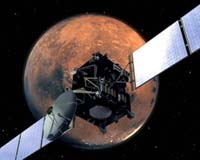
Paris, France (ESA) Jan 05, 2007 The reporting period covers two weeks of active cruise for Rosetta, including the last Active Checkout week and a thermal characterisation. The first payload Active Checkout campaign, which started on 22 November, was completed on 22 December. During the reporting period, the operated instruments included ALICE, OSIRIS, ROSINA, COSIMA, MIDAS, RPC and SREM. In particular, interactive checkout operations were performed with ROSINA, RPC, MIDAS, OSIRIS and COSIMA. RPC and SREM remain active in the background throughout the campaign. The other instruments are only activated for execution of their checkout sequences. All checkout operations during the reporting period have executed smoothly, except for one non-interactive RPC Ion and Electron Sensor (IES) activity on 19 December. An interactive OSIRIS health check was performed over DSN on 20 and 21 December and confirmed that the instrument is fully operational. On 27 December, a thermal characterisation was performed to confirm that the spacecraft can remain indefinitely in an attitude corresponding to a solar aspect angle (SAA) of 140 for Sun distances of 1.2 AU or above. The test was successful. Though the front thrusters showed a large temperature increase, reaching a maximum of 48.3 C (thruster 11), all monitored thermistors reached steady state temperatures well within their defined limits. A total of 6 New Norcia (NNO) passes of 12.25 hours commanding were taken during the reporting period. Five tracking passes of 4 hours and one delta-DOR measurement have been taken with DSN. At the end of the reporting period (DOY 363) Rosetta was at 309.2 million km from Earth (2.07 AU; one-way signal travel time was 16 minutes 33 seconds). The distance to the Sun was 180.6 million km (1.21 AU).
Spacecraft Thermal Characterisation The thermal behaviour of the spacecraft is nominal and stable. Rosetta remains configured for Active Near Sun cruise (ACM1 since DOY 207/2006). The Platform Thermal Monitoring application program triggered twice on DOY 353 due to crossing of the low temperature threshold for the -X SAS (Sun Acquisition Sensor) and MGA-X (Medium Gain Antenna) as the attitude was changed to a solar aspect angle of more than 90. These triggers serve as notifications and there is no need for the software to take action upon them. The 90 limit defined on-board, is well below the critical value defined in the Rosetta System Data Base (RSDB). A thermal characterisation was performed on DOY 361/362 to confirm that the spacecraft can sustain thermally an attitude corresponding to a solar aspect angle (angle between the +Z spacecraft axis and the Sun direction) of 140 at Sun distances down to 1.2 AU. This attitude had already been characterised successfully in May 2005 (see also Status Report No. 42), but only for a duration of 12 hours, insufficient to observe the temperatures reaching steady state. This time, the spacecraft remained in the characterisation's attitude for 24 hours. The monitored units included the front and bottom thrusters and the NTO tank temperatures. All units showed a clear temperature increase, but remained within the defined limits and reached steady state during the test. The maximum temperature was reached by thruster 11 (bottom thruster on +X side), which reported 48.3 C during the test. This is within the soft limit of 55 C defined for these thrusters. The Platform Thermal Monitoring application program reported an out-of-limit on the -X SAS and the MGA-X temperature during the test. No action was taken by the on-board software, and the actual unit temperatures were well within their RSDB-defined limits. The Payload Thermal Monitoring application program triggered twice on the same line during the test, because the RPC IES temperature went below -10 C during the thermal characterisation. The on-board software switched ON the corresponding heater line on PL-LCL 40A, but the temperature kept dropping, stabilising around -14 C. The lower soft limit defined for this parameter is -35 C. Future Milestones: The Mars Swingby Phase formally started on 28 July 2006. The actual swingby will take place on 25 February 2007, followed by a Deep Space Manoeuvre in April 2007. The next short-term activities include an observation of asteroid Lutetia by OSIRIS between 2 and 4 January, and a test of the pre-eclipse Mars observation attitude on 7 January. Related Links Rosetta All about the technology of space and more The Iron and Ice Of Our Solar System  Radar Love: Asteroid Detection And Science
 Pasadena CA (SPX) Dec 21, 2006
They are the celestial equivalent of sonograms. But their hazy outlines and ghostly features do not document the in-vivo development of a future taxpayer. Instead, they chronicle the exo-planetary comings-and-goings of some of Earth's least known, most nomadic, and at times most impactful neighbors. |
|
|

| The content herein, unless otherwise known to be public domain, are Copyright 1995-2006 - SpaceDaily.AFP and UPI Wire Stories are copyright Agence France-Presse and United Press International. ESA PortalReports are copyright European Space Agency. All NASA sourced material is public domain. Additionalcopyrights may apply in whole or part to other bona fide parties. Advertising does not imply endorsement,agreement or approval of any opinions, statements or information provided by SpaceDaily on any Web page published or hosted by SpaceDaily. Privacy Statement |