|
 |
 |
 |
 |
 |
 |
 |
 |
 |

| . |  |
. |
Indonesias Capital Braces For Potential Flood Catastrophe
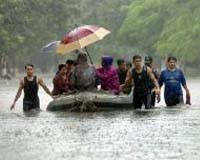
Jakarta, Indonesia (AFP) Feb 22, 2006 Ade Subrayat, 55, points to the bench he has to tie down as part of his battle against the regular floods that engulf his riverside home in the Indonesian capital during the annual monsoon. "The water often rises at my home to 1.2 metres (yards). Sometimes the waters come twice a week," he complains. "When the river overflows, I tie down my furniture so it doesn't get carried away." Sometimes the water invades the next storey up too, where retired Subrayat, his wife, their four children and his sister huddle around the radio and television. "The problem is at night, when the water comes quickly. Then we lose kitchen utensils, mattresses, beds, books," sister Nemi Herni explains. Major cities such as Tokyo and Los Angeles are braced for their "Big One": a major earthquake. In Jakarta, the dreaded catastrophe is a killer flood. Flooding is a daily fear in the Indonesian capital during the monsoon season, peaking in January or February, with radio reports delivering the bad news: 80 centimetres (32 inches) of water here, a street impassable there. In 2002, floods killed as many as 40 Jakartans and some 300,000 were forced to seek refuge in mosques, schools and even cemeteries. But the city, struggling with unbridled growth, remains ill-prepared for a disaster. Some 13 rivers crisscross Jakarta, with 78 zones considered at risk of easily flooding, including Kampung Melayu, a densely-populated district of some 26,000 clinging to Ciliwung River's edge -- among them Subrayat's family. In 2003, French charity Action Against Hunger (ACF) began working with local authorities on flood preparations for Melayu, including a draft evacuation plan involving first-aid workers and the provision of food and shelter. As in other flood-prone areas, the main concern with Melayu is the drainage. An ACF study showed that 78 percent of residents directly throw their rubbish into the river, with the debris effectively clogging the waterway. "However, people know now that it is a problem, that it contaminates, that it creates blockages, that it permanently raises the riverbed," says Edward Turvill, who manages the program. A rise of 1.4 metres of the river can easily displace 1,000 people, and it has already risen once to 6.5 metres. It can sometimes be too late for people to evacuate using the rooftops, so search and rescue teams have to intervene. The anarchic growth of the megalopolis of Jakarta, where some 20 million inhabitants are largely deprived of open spaces thanks to a dire lack of parks, only aggravates the situation. "There is a compacting of the ground due to a combination of the strong extraction of groundwater, the construction of buildings, and weight of the concrete of the roads and around the houses," Turvill says. Old Batavia, the former colonial port under the Dutch from where Jakarta has expanded, was built on marshland. Certain areas of the capital still remain below sea level and have weak drainage, with major tides resulting in the outflow of rainwater slowing down. To improve the situation, authorities have for a long time envisioned constructing a so-called East Jakarta Canal that would be some 24 kilometres (15 miles) long. Only around five kilometres have actually been constructed. "It is very difficult for us to build because we have had to acquire land," Donny Azdan, head of the ministry of planning's water resources and irrigation directorate, tells AFP. As for the West Jakarta Canal constructed by the Dutch, its bed has narrowed due to the thousands of destitute who have illegally built along its edges -- many of whom cannot swim. The issue is also political, with reservoirs that overfill after heavy rains needing to be diverted, but those in poorer areas claiming that suburbs where the well-heeled live are unfairly protected. Infuriated residents have smashed gates in order to distribute the flood waters elsewhere, but sometimes even nature does not spare the rich. In 2002, the rainwater volume was so huge that Menteng, populated by Jakarta's elite, was inundated. But as Turvill says: "If there is a major catastrophe, it is the poor who will suffer most."
Source: Agence France-Presse Related Links -  Oceans Becoming More Acidic Than When Dinosaurs Died
 Honolulu, Hawaii (SPX) Feb 21, 2006
Research shows increased carbon dioxide emissions in the atmosphere are rapidly making the world's oceans so acidic they could cause a mass extinction of marine life similar to one that occurred 65 million years ago when the dinosaurs disappeared. |
|
|

| The content herein, unless otherwise known to be public domain, are Copyright 1995-2006 - SpaceDaily.AFP and UPI Wire Stories are copyright Agence France-Presse and United Press International. ESA PortalReports are copyright European Space Agency. All NASA sourced material is public domain. Additionalcopyrights may apply in whole or part to other bona fide parties. Advertising does not imply endorsement,agreement or approval of any opinions, statements or information provided by SpaceDaily on any Web page published or hosted by SpaceDaily. Privacy Statement |