. Earth Science News .
Ion Thrusters Propel NASA Into Future

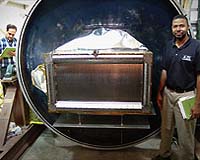
George Williams (left) and Dr. John Foster (right) get ready to test an early version of the high-power ion thruster. While this thruster is rectangular, Herakles will be round. Credit: NASA.

Cleveland OH (SPX) May 31, 2005
President Bush's Vision for Space Exploration calls for human and robotic missions to the Moon, Mars and beyond. To realize these ambitious goals, the United States will need more powerful and efficient propulsion and power-generation systems - systems that can thrust a spacecraft out of Earth's orbit to the far reaches of the Universe.

NASA's primary research program for developing these technologies is Prometheus Nuclear Systems and Technology. Named for the ancient Greek god of fire and craft, Prometheus has two initial objectives:

1. To develop nuclear-powered propulsion systems

2. To build Prometheus 1, a spacecraft that could conduct far-reaching, long-lasting exploration missions

Prometheus 1 would launch using conventional chemical rockets. But once in Earth's orbit, a nuclear electric propulsion system would propel it through space.

Nuclear electric propulsion is over 10 times more efficient than chemical rockets and produces 20 times more power than the generators used on space probes such as Voyager and Cassini or solar-powered systems like Deep Space 1.

Coupled with traditional rocket launchers, nuclear electric propulsion would allow spacecraft to travel farther and faster and to perform in-flight course changes and precise maneuvers.

It would also carry heavier, power-hungry equipment, including precise cameras, sophisticated scientific instruments, high-speed computers and advanced communication systems.

"A nuclear electric propulsion system could propel and power at least ten times as much payload science as other systems," said Research Engineer Steve Oleson of the NASA Glenn Research Center. "It could allow a spacecraft to beam more information back to Earth."

As a result, scientists could closely study the surfaces of the outer planets and their moons as well as the surfaces and interiors of comets.

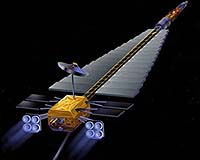
In a nuclear electric propulsion system, a nuclear reactor produces heat, a power-conversion system converts the heat to electricity, and an ion thruster uses the electricity to propel the spacecraft.


Related Links
NASA Glenn Research Center
SpaceDaily
Search SpaceDaily
Subscribe To SpaceDaily Express

Cosmos 1 Ships In Preparation For June Launch
Severomorsk, Russia (SPX) May 24, 2005
Cosmos 1, the world's first solar sail spacecraft, has shipped in preparation for a launch window that opens on June 21, 2005, traveling from the test facility of Lavochkin Association in Moscow to Severomorsk, Russia.


  • ESA's Epidemio And Respond Assist During Angolan Marburg Outbreak
  • DigitalGlobe Imagery Helps Establish Refugee Camps In Indonesia
  • Charter Activation Brings Space Dimension To European Emergency Exercise
  • Insects, Viruses Could Hold Key For Better Human Teamwork In Disasters

  • Climate: The Importance Of Being Ernest
  • Burnt Coal From Dinosaur Age Sheds Light On Today's Global Warming
  • New Study Projects Drought In Southern Africa, Rain In Sahel
  • New Antarctic Radar Enables Scientists To Study Earth's Mesosphere

  • DigitalGlobe Provides Imagery Of Kauai County For Floodplain Mapping
  • Shanghai-Made Orbiter To Improve Forecasts
  • Adaptive Array Network Could Improve Access To NASA's EO Satellites
  • Climate: A Race Through Thick And Thin Ice

  • Jefferson Lab Builds First Single Crystal Single Cell Accelerating Cavity
  • First Major Grass-Burning Power Station Planned For Britain This Year
  • Japan Sets Concessions To Give Breakthrough Reactor Project To EU: Report
  • Russia To Build Floating Nuclear Plant


  • Microbes In Colorful Yellowstone Hot Springs Fueled By Hydrogen
  • SAfrican Government Consults Scientists On Elephant Culling
  • NASA Analyzes Prehistoric Predator From The Past
  • Scientists Discover Unique Microbe In California's Largest Lake


  • The content herein, unless otherwise known to be public domain, are Copyright 1995-2006 - SpaceDaily.AFP and UPI Wire Stories are copyright Agence France-Presse and United Press International. ESA PortalReports are copyright European Space Agency. All NASA sourced material is public domain. Additionalcopyrights may apply in whole or part to other bona fide parties. Advertising does not imply endorsement,agreement or approval of any opinions, statements or information provided by SpaceDaily on any Web page published or hosted by SpaceDaily. Privacy Statement