|
 |
 |
 |
 |
 |
 |
 |
 |
 |

| . |  |
. |
Mars Doubles In Brightness
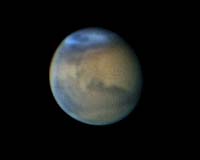
Pasadena CA (SPX) Nov 26, 2007 During the past month, Mars has doubled in brightness and it is putting on a nice show for backyard stargazers. "Mars is starting to look really nice through my 10-inch telescope," reports amateur astronomer Friedrich Deters of LaGrange, North Carolina, who took the picture at right on Nov. 17th. "Very nice!" agrees Dan Peterson of Racine, Wisconsin, who captured a similar snapshot the next night. The blue polar swirl in these pictures is the "North Polar Hood"-a giant icy cloud that forms over the Martian north pole during winter. Why blue? That's the color of sunlight scattered from very tiny crystals of ice (smaller than the wavelength of light itself) floating in the cloud. The blue hood vs. Mars' red terrain appear in pleasing contrast through any mid-sized backyard telescope. You don't need a telescope to enjoy Mars, however. It is plainly visible to the naked eye, bright and red, standing out among the pale stars of Gemini as something definitely different. Finding the constellation and the planet within is child's play on Nov. 26th and 27th. That's when the nearly full Moon glides past Mars, only one degree away, and draws attention to the pair. If you can find the full Moon, you can find Mars. Look east before bedtime on Monday evening, Nov. 26th, or west before dawn on Tuesday morning, Nov. 27th. Take a cup of coffee outside on Nov. 27th and spend some time sipping it while the sun rises and a hint of blue infuses the twilight sky. The sight of the silver Moon and red Mars backlit by blue sky is breathtaking. Sky maps: Nov. 26, Nov. 27. Why has Mars gotten so bright and attractive? It's because Earth and Mars are converging. At closest approach on Dec. 18th, the two worlds will lie only 55 million miles apart. That may sound like a great distance, but it is just a hop, skip and a jump on the vast scale of the solar system. NASA is taking advantage of the close encounter to send a new mission to Mars: the Phoenix Lander. Phoenix launched in August 2007 and is due to reach Mars in May 2008, joining the Mars rovers Spirit and Opportunity already there. Take a look at Mars: If it is this good now, what will it be like in December? Stay tuned! Community Email This Article Comment On This Article Related Links Astronomy News from Skynightly.com
 A Fantastic Monday Morning Sky Show
 Huntsville AL (SPX) Nov 05, 2007
This is worth waking up for. On Monday morning, Nov. 5th, anyone willing to step outside before dawn will see a fantastic display of stars and planets-and maybe a couple of spaceships, too. |
|
|

| The content herein, unless otherwise known to be public domain, are Copyright 1995-2007 - SpaceDaily.AFP and UPI Wire Stories are copyright Agence France-Presse and United Press International. ESA Portal Reports are copyright European Space Agency. All NASA sourced material is public domain. Additional copyrights may apply in whole or part to other bona fide parties. Advertising does not imply endorsement,agreement or approval of any opinions, statements or information provided by SpaceDaily on any Web page published or hosted by SpaceDaily. Privacy Statement |