|
 |
 |
 |
 |
 |
 |
 |
 |
 |

| . |  |
. |
Messenger Completes Venus Flyby
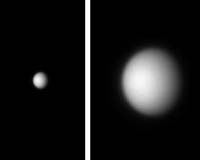
Laurel MD (SPX) Oct 25, 2006 NASA's Mercury-bound Messenger spacecraft came within 2,990 kilometers (1,860 miles) of the surface of Venus early this morning during its second planetary encounter. The spacecraft used the tug of the planet's gravity to change its trajectory significantly, shrinking the radius of its orbit around the Sun and bringing it closer to Mercury. Messenger swung by Venus at 8:34 UTC (4:34 a.m. EDT), according to mission operators at the Johns Hopkins University Applied Physics Laboratory (APL) in Laurel, Md. About 18 minutes after the approach, an anticipated solar eclipse cut off communication between Earth and the spacecraft. Contact was reestablished at 14:15 UTC (10:15 a.m. EDT) through NASA's Deep Space Network, and the team is collecting data to assess Messenger's performance during the flyby. Shortly before the Venus flyby the spacecraft entered superior conjunction, placing it on the exact opposite side of the sun as Earth, making communication between Messenger and Mission Operations difficult, if not impossible. "So we are not making any scientific observations at the time of this flyby," says Sean C. Solomon, the mission's principal investigator, from the Carnegie Institution of Washington. "We shall conduct a full suite of observations surrounding the second flyby in June 2007." In late November, when routine radio contact with the spacecraft is re-established, the team will collect data to determine how closely Messenger followed its plans and to update knowledge of its orbit. This information will enable operators to plan for the December 12 trajectory correction maneuver that will target the spacecraft for the second Venus flyby. The spacecraft is relying on multiple planetary flybys to "catch" Mercury and begin orbiting the planet. Another flyby of Venus in June of 2007 will further alter the spacecraft's orbit so that it will fly by Mercury in January of 2008. Three close approaches to Mercury will be required to bring the velocity of Messenger close enough to the orbital velocity of Mercury such that its main engine can brake the spacecraft into Mercury orbit in March of 2011. Earlier this month, the Messenger Dual Imaging System (MDIS) snapped pictures of Venus from a distance of about 16.5 million kilometers (10.3 million miles). Those images are available online at Despite the low resolution of the images, it's possible to see that Venus is shrouded in a thick blanket of clouds that hides its surface. Also available online are updated animations, one showing Venus from the spacecraft from 90 minutes before to 90 minutes after the flyby, including the time of the eclipse.. Messenger will conduct the first orbital study of Mercury, the least explored of the terrestrial ("rocky") planets that also include Venus, Earth and Mars. Over one Earth year- or four Mercury years - Messenger will provide the first images of the entire planet and collect detailed information on the composition and structure of Mercury's crust, its geologic history, the nature of its atmosphere and magnetosphere, and the makeup of its core and polar materials. Messenger, short for MErcury Surface, Space ENvironment, GEochemistry, and Ranging, is the seventh mission in NASA's Discovery Program of lower cost, scientifically focused exploration projects. APL designed, built and operates the Messenger spacecraft and manages the mission for NASA's Science Mission Directorate. Related Links Messenger at APL Stellar Chemistry, The Universe And All Within It  Mercury Messenger Probe Flips Sunshade Towards The Sun
 Laurel MD (SPX) Jun 23, 2006
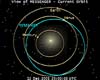
The Messenger spacecraft performed its final "flip" maneuver for the mission on June 21. Responding to commands sent from the Messenger Mission Operations Center at The Johns Hopkins University Applied Physics Laboratory (APL) in Laurel, Md., through NASA's Deep Space Network antenna station near Goldstone, Calif., the spacecraft rotated 180 degrees, pointing its sunshade toward the Sun. |
|
|

| The content herein, unless otherwise known to be public domain, are Copyright 1995-2006 - SpaceDaily.AFP and UPI Wire Stories are copyright Agence France-Presse and United Press International. ESA PortalReports are copyright European Space Agency. All NASA sourced material is public domain. Additionalcopyrights may apply in whole or part to other bona fide parties. Advertising does not imply endorsement,agreement or approval of any opinions, statements or information provided by SpaceDaily on any Web page published or hosted by SpaceDaily. Privacy Statement |