|
 |
 |
 |
 |
 |
 |
 |
 |
 |

| . |  |
. |
NASA, Spacehab Seek To Advance Air Monitoring Technology
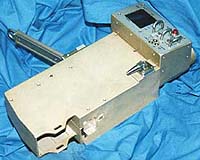
Houston TX (SPX) May 26, 2005 Through a new, two-year joint-research partnership with Spacehab, NASA will begin testing miniature mass spectrometers, devices that can detect and measure pollutants, for advances in air quality management. As a result, development of a compact, portable system may help clear the air in spacecrafts and homes by monitoring air contaminants. Mass spectrometer technology provides a powerful tool to monitor volatile compounds, such as carbon monoxide and nitrogen, in air. The device probes the chemical molecules in the air, breaking them up into fragments and, by use of magnetic fields, deflects them to identify and measure their concentration levels. "In space, we worry about air pollution that may adversely affect crewmembers' health," said John James, chief toxicologist at NASA's Johnson Space Center. "The air they breathe gets filtered, but it is then recycled many times, which can cause the accumulation of potentially harmful contaminants. We need a way to tell us when the air is polluted and to help us pinpoint the source." For example, if the device detects halon, a chemical used in fire extinguishers, it might suggest equipment leakage. If the levels of a chemical generally found in lower concentrations suddenly increases, it could suggest the air cleaning system is failing. Mass spectrometers on the market typically weigh about 100 lbs. And take up the space of a car trunk. Manufacturers of the systems have reduced some mass spectrometers to suitcase size but these are still large for space use. As NASA prepares to go back to the Moon and further in space, it seeks a device that could fit inside a lunar habitat or Mars spacecraft to monitor the atmosphere with immediate results. NASA's partner, Spacehab, has teamed up with Zyvex, a company that specializes in nanotechnology, to scale down the size of available mass spectrometers. "Developing, transporting, and installing large, complex detection and classification equipment on orbit is extremely problematic," said Michael E. Bain, Spacehab chief operating officer. "We are excited about this opportunity to provide a solution that is small, lightweight, and portable enough to be easily delivered to, and operated anywhere humans live and work in space." Researchers aim to reduce the equipment's size to that of a deck of playing cards while increasing accuracy and response time. Lower manufacturing costs may also reduce purchase costs of the advanced air quality systems. The new technology also may find uses on Earth. Smaller monitoring devices may be useful for security measures to detect chemicals or locate explosives. Advances in air quality monitors also may better detect unsafe levels of carbon monoxide or formaldehyde, a common chemical found in new furnishings and carpeting in homes. "In general, the air inside a house is dirtier than the air outside," James said. "Advancing technologies for space can serve us on Earth, just as the many innovations that came out of NASA's first missions to the Moon did and still do today." Under the non-reimbursable Space Act Agreement negotiated with Spacehab through JSC's Technology Transfer and Commercialization Office, NASA research and facilities will join with private-industry expertise to enhance the development. Related Links Zyvex Spacehab SpaceDaily Search SpaceDaily Subscribe To SpaceDaily Express  Space Watch: Signs Of A Renaissance
 Washington (UPI) May 26, 2005
There may be many problems apparent at NASA and among the U.S. aerospace giants these days, but there also are signs that space exploration is about to undergo a renaissance, with an explosion of creativity unseen in decades. |
|
|

| The content herein, unless otherwise known to be public domain, are Copyright 1995-2006 - SpaceDaily.AFP and UPI Wire Stories are copyright Agence France-Presse and United Press International. ESA PortalReports are copyright European Space Agency. All NASA sourced material is public domain. Additionalcopyrights may apply in whole or part to other bona fide parties. Advertising does not imply endorsement,agreement or approval of any opinions, statements or information provided by SpaceDaily on any Web page published or hosted by SpaceDaily. Privacy Statement |