|
 |
 |
 |
 |
 |
 |
 |
 |
 |

| . |  |
. |
Opportunity Rolls South Across Meridiani Planum To Crater Argo
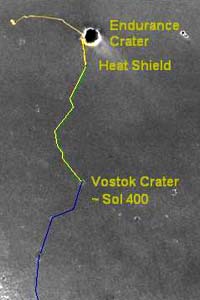
Pasadena CA (JPL) Jan 31, 2005 After spending 25 sols at the heat shield and nearby meteorite, Opportunity has completed its investigation of both and has started a long migration south. The rover is currently heading for a small crater called "Argo." Dust storms in the vicinity of Meridiani Planum appear to be settling down, and solar power has stabilized. On Jan. 24, 2005, the rover team celebrated Opportunity's first anniversary (one Earth year) on Mars. The rover continues to be in excellent health for its long drives out on the plains of Meridiani. Sol 353 was a restricted sol. (Results of 352 drive were not known by the planning team in time to calculate the final heat shield approach). Opportunity performed over two hours of observations using the panoramic camera and miniature thermal emission spectrometer. On sol 354, Opportunity performed 10 minutes of pre-drive remote-sensing observations, then moved forward to get in final position for extending its instrument deployment device (robotic arm) to the heat shield. A drive of 0.7 meter (2.3 feet) was successful, placing the heat shield in reach of the arm. Opportunity performed more than an hour of post-drive imaging. Sol 355 was a restricted sol. Opportunity performed over two hours of remote sensing. Sols 356 and 357 were planned in a single planning cycle. On sol 356, Opportunity used the microscopic imager to examine the heat shield. Using the arm to position the microscopic imager, Opportunity spent 90 minutes collecting high-resolution images of the heat shield. On sol 357, the rover performed thermal inertia measurements throughout the sol. Using the miniature thermal emission spectrometer to image the same target at different times, Opportunity took measurements as late as 23:00 Mars local solar time. On sol 358, Opportunity retook some microscopic images of the heat shield with the dust cover open. The rover then stowed its arm and began its drive south, away from the heat shield. Opportunity is now headed for a small crater called Argo, which is approximately 300 meters (about 984 feet) away. Opportunity successfully covered 86.3 meters (283 feet) on this sol. Sol 359, which ended on Jan. 27, was another restricted sol. The rover was sent commands for over 2.5 hours of remote sensing. Total odometry as of sol 358 is 2,200.6 meters (1.37 miles). Related Links Mars Rovers at JPL SpaceDaily Search SpaceDaily Subscribe To SpaceDaily Express  A Glow In The Martian Night
 Moffet Field CA (SPX) Jan 31, 2005
Jean-Loup Bertaux, of the Service d'Aeronomie du CNRS in France, is Principal Investigator for the spectrometer instrument onboard the ESA's Mars Express orbiter. His SPICAM instrument team detected a night glow on Mars, and they have now published their discovery in the January 28th edition of the journal Science. He sat down with Astrobiology Magazine editor Leslie Mullen to discuss this new finding, and describe how it could aid future missions to Mars. |
|
|

| The content herein, unless otherwise known to be public domain, are Copyright 1995-2006 - SpaceDaily.AFP and UPI Wire Stories are copyright Agence France-Presse and United Press International. ESA PortalReports are copyright European Space Agency. All NASA sourced material is public domain. Additionalcopyrights may apply in whole or part to other bona fide parties. Advertising does not imply endorsement,agreement or approval of any opinions, statements or information provided by SpaceDaily on any Web page published or hosted by SpaceDaily. Privacy Statement |