|
 |
 |
 |
 |
 |
 |
 |
 |
 |

| . |  |
. |
Outside View: Who Needs The NPT?
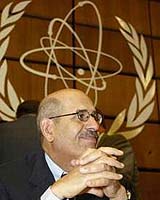
Moscow, (UPI) June 6, 2005 The Seventh Review Conference of the Parties to the Treaty on the Non-Proliferation of Nuclear Weapons all but said this important institution of global politics ineffective. After four weeks of hard work at the U.N. headquarters, the Conference still failed to solve the key problem, i.e., how the NPT could be transformed into a genuinely efficient mechanism governing the non-proliferation of weapons of mass destruction. After all, this problem questions the quality of the document itself. On the eve of the Conference, observers desperately wanted an answer to a single question: Will this prominent international forum revise the fundamental articles of the Treaty to bring it closer to modern realities? The question arose for many reasons and has been occupying the minds of experts for a long time. It is not a coincidence that director of the International Atomic Energy Agency Mohammad ElBaradei warned the participants on the first day of the conference that the existence of breaches and loopholes in the treaty would lead to the appearance of 30-40 virtual nuclear powers in the next two decades. These powers will appear largely because they will be able to enrich uranium without formally violating the fundamental provisions of the NPT. Iran is a good example because even now it uses a loophole to develop its uranium enrichment programs. North Korea is another example. It managed to acquire all the necessary technologies within the framework of the NPT, then abandoned the treaty and announced to the whole world that it could create its own nuclear weapons. These examples naturally raise a question: Has the treaty become obsolete? The Treaty was signed in 1968 and entered into force in 1970. It established the nuclear status of five nations -- Britain, China, France, Russia and the United States. In other words, it legalized the nuclear arsenals of members of the so-called Nuclear Club, and forbade other countries that signed the treaty to create or buy nuclear weapons. At that time, such discrimination was reasonable. It was needed to prevent these terrible weapons from spreading. Besides, the members of the Nuclear Club not only gave assurances they would not transfer dual-purpose nuclear technologies to other countries but also promised to destroy their own nuclear arsenals gradually. However, after 35 years, the Nuclear Club continues to maintain silently military nuclear arsenals and the non-proliferation regime shows clear signs of failure -- all within the framework of the current Treaty. According to Russian experts, such questions as whether Iran will succeed with its nuclear weapons program are purely technical issues that do not require the revision of the treaty. An additional protocol, which will oblige a country to return or destroy the nuclear technologies received within the framework of the NPT in the event of its withdrawal from the Treaty (the North Korean example), would be enough to regulate them. Nevertheless, there is no doubt that the NPT has to be adapted to new realities. The attitude of non-nuclear NPT members toward the countries of the Nuclear Club is also gradually becoming an urgent issue, because the latter clearly fail to meet their obligations on nuclear disarmament. Virtual nuclear powers like India, Pakistan and Israel remain outside the NPT even now. These are states located in regions where the probability of military conflicts, including with the use of nuclear weapons, is particularly high. While Israel links its accession to the NPT with a general resolution of the Middle East crisis, India and Pakistan regard such a possibility only as official members of the Nuclear Club, therefore, encroaching on the exclusive right of the current members to initiate and regulate all innovations in the sphere of nuclear weapons. The conference failed to solve any of these problems. The NPT members simply decided to make another attempt during the eighth review conference in five years. According to observers, the participants unanimously agreed to take this step. It remains doubtful, though, that the NPT, in its current state will be effective enough to solve the existing problems; therefore, there is little hope the next conference will bring any changes. On the one hand, it is hard to imagine what our world would be like if it did not have nuclear weapons. On the other hand, it is frightening to imagine what would happen to the world if anybody had unrestricted access to nuclear weapons. There are certainly many forces that desire such access and pose a question: why did the current "legal" owners of nuclear weapons usurp the right to possess them in the first place? It seems these questions will hardly disappear on their own before the next conference. Pyotr Goncharov is commentator for RIA-Novosti. The opinions expressed in this article are those of the author and may not necessarily represent the opinions of the RIA Novosti editorial board. This article is reprinted by permission of RIA Novosti.)
(United Press International's "Outside View" commentaries are written by outside contributors who specialize in a variety of important issues. The views expressed do not necessarily reflect those of United Press International. In the interests of creating an open forum, original submissions are invited.) Related Links SpaceDaily Search SpaceDaily Subscribe To SpaceDaily Express  Analysis: China And Nuclear Power
 Beijing, (UPI) June 6, 2005
China's incessant demand for energy to fuel its burgeoning economy includes doubling nuclear power use by 2020, a leading industry official said Monday. |
|
|

| The content herein, unless otherwise known to be public domain, are Copyright 1995-2006 - SpaceDaily.AFP and UPI Wire Stories are copyright Agence France-Presse and United Press International. ESA PortalReports are copyright European Space Agency. All NASA sourced material is public domain. Additionalcopyrights may apply in whole or part to other bona fide parties. Advertising does not imply endorsement,agreement or approval of any opinions, statements or information provided by SpaceDaily on any Web page published or hosted by SpaceDaily. Privacy Statement |