 |
 |
 |
 |
 |
 |
 |
 |
 |
 |

| . |  |
. |
Photon-Transistors For The Supercomputers Of The Future
Copenhagen, Denmark (SPX) Aug 27, 2007 Scientist from the Niels Bohr Institute at University of Copenhagen and from Harvard University have worked out a new theory which describe how the necessary transistors for the quantum computers of the future may be created. The research has just been published in the scientific journal Nature Physics. Researchers dream of quantum computers. Incredibly fast super computers which can solve such extremely complicated tasks that it will revolutionize the application possibilities. But there are some serious difficulties. One of them is the transistors, which are the systems that process the signals. Today the signal is an electrical current. For a quantum computer the signal can be an optical one, and it works using a single photon which is the smallest component of light. "To work, the photons have to meet and "talk", and the photons very rarely interact together" says Anders Sondberg Sorensen who is a Quantum Physicist at the Niels Bohr Institute at Copenhagen University. He explains that light does not function like in Star Wars, where the people fight with light sabres and can cross swords with the light. That is pure fiction and can't happen. When two rays of light meet and cross, the two lights go right through each other. That is called linear optics. What he wants to do with the light is non-linear optics. That means that the photons in the light collide with each other and can affect each other. This is very difficult to do in practice. Photons are so small that one could never hit one with the other. Unless one can control them - and it is this Anders Sorensen has developed a theory about.
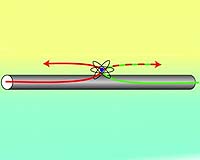
Light collisions at the quantum level The atom can only absorb one photon (such are the laws of physics). If you now direct two photons towards the atom it happens that they will collide on the atom. It is exactly what he wants. The atom is however very small and difficult to hit. So the photons have to be focussed very precisely. In a previous experiment researchers had discovered that microwaves could be focussed on an atom via a superconducting nano-wire. They got the idea that the same could happen with visible light. The theoretical model shows that it works. The atom is brought close to the nanowire. Two photons are sent towards the atom and when they hit it an interaction occurs between them, where one imparts information to the other. The information is sent in bits which are either a one or zero digit, and the order of digits produces the message. (Today we can send information via an optic cable and each bit is made up of millions of photons.) In quantum optics each bit is just one photon. The photon has now received its message and the signal continues on its way. It is a step on the way to building a photon-transistor for a quantum computer. Community Email This Article Comment On This Article Related Links Danish National Research Foundation Center for Quantum Optics Space Technology News - Applications and Research
 Sharp develops super-thin LCD TV
 Tokyo (AFP) Aug 22, 2007
Japan's Sharp Corp. said Wednesday it had developed a liquid crystal display television that is less than an inch thick. |
|
|

| The content herein, unless otherwise known to be public domain, are Copyright 1995-2007 - SpaceDaily.AFP and UPI Wire Stories are copyright Agence France-Presse and United Press International. ESA Portal Reports are copyright European Space Agency. All NASA sourced material is public domain. Additional copyrights may apply in whole or part to other bona fide parties. Advertising does not imply endorsement,agreement or approval of any opinions, statements or information provided by SpaceDaily on any Web page published or hosted by SpaceDaily. Privacy Statement |