|
 |
 |
 |
 |
 |
 |
 |
 |
 |

| . |  |
. |
Russia says Iran rocket raises nuclear suspicions: report
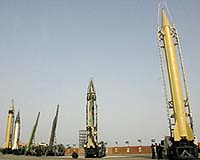
Moscow (AFP) Feb 6, 2008 A rocket fired into space by Iran earlier this week raises "suspicions" over Tehran's claims to have no ambitions to build a nuclear weapon, a Russian foreign ministry official told domestic news agencies Wednesday. "Any movement on creating a weapon of such potential of course worries others too, and, in addition, raises suspicions concerning Iran over its possible desire to create a nuclear weapon," Deputy Foreign Minister Alexander Losyukov was quoted as saying by Interfax and RIA Novosti. "A long-range rocket is one of the components of such a weapon complex. Of course it provokes concern," Losyukov was quoted by Interfax as saying. Losyukov's comments marked a change in tone for Moscow, which has staunchly defended Tehran's civilian nuclear ambitions and denied US-led allegations that Iran poses a security threat or is planning to build a nuclear weapon. Russian engineers are close to finishing Iran's first atomic power station at Bushehr, which is to be powered with Russian-supplied uranium. Iran described the object fired Monday as a "sounding rocket" that commemorated the opening of the country's first space centre and conducted experiments paving the way for the launch of the first Iranian-made satellite. State television pictures showed the firing of the rocket from its vertical launch but no information was released on what height it reached or what data it produced. The rocket bore a resemblance to Iran's Shahab-3 missile, which has a range of 1,300 to 1,600 kilometres (800 to 1,000 miles), enough to put arch regional foe Israel and US bases in the Gulf within range. The United States on Monday described the rocket as "a ballistic missile" and said the test was "unfortunate... because it further isolates the country from the rest of the world." Meanwhile, Interfax quoted a retired head of Russian strategic missile forces, General Viktor Yesin, as saying that Iran had shown it has the potential to build a ballistic missile with a range of up to 4,000 kilometres (2,485 miles). "I wouldn't be surprised if such missiles appear in Iran in the coming years," he said. Community Email This Article Comment On This Article Related Links Rocket Science News at Space-Travel.Com
 Companies Team Up For Advanced Airbag Landing And Flotation System For Orion Vehicle
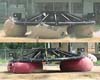 Frederica DE (SPX) Feb 01, 2008
Airborne Systems North America (ASNA) and ILC Dover LP have signed an agreement to work together on the Orion airbag landing and floatation system. A new study initiated by NASA is underway for a "singular" landing system that works for land and water landings and protects the Astronauts in contingency landing situations. |
|
|

| The content herein, unless otherwise known to be public domain, are Copyright 1995-2007 - SpaceDaily.AFP and UPI Wire Stories are copyright Agence France-Presse and United Press International. ESA Portal Reports are copyright European Space Agency. All NASA sourced material is public domain. Additional copyrights may apply in whole or part to other bona fide parties. Advertising does not imply endorsement,agreement or approval of any opinions, statements or information provided by SpaceDaily on any Web page published or hosted by SpaceDaily. Privacy Statement |