|
 |
 |
 |
 |
 |
 |
 |
 |
 |

| . |  |
. |
Water Supply Key To Gender Equality In Developing World: Experts
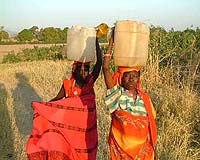
Stockholm (AFP) Aug 29, 2005 Men and women are not equal faced with the water scarcity afflicting most of the planet, and easier access to clean water is a key factor for gender equality, experts said at the Stockholm Water Week. Like the Indian girl in Disney's Jungle Book movie who "must go and fetch the water 'till the day that I am grown", hundreds of millions of girls and women walk long distances for hours every day to provide their families with water, leaving little time for anything else. "Carrying water is their role. Young girls will carry water for long distances," said Vanessa Tobin, head of UNICEF's water, environment and sanitation section. "In a country like Niger, it's up to four or five hours a day. That workload then often means that they drop out of school," she told AFP on the margins of the symposium which ended at the weekend. "Just think of the things that women could be doing during all the hours they spend fetching water." In Africa and Asia, the average daily walk for girls and women to fetch water is six kilometres (3.7 miles) and they each carry 20 kilograms (44 pounds) of water on average on their heads. And if young girls are not too exhausted to go to school afterwards, their parents may well pull them out anyway, judging that their help at home is more important than an education and the opportunities that come with it. But even if they stay on, they face the thorny problem of lacking sanitary facilities due to water shortages which makes everyone's school day a misery, but especially that of girls in their teens. "When they begin to menstruate, girls might stay away from school for a week every month because there are no sanitary facilities," Mamphono Khaketla, Lesotho's minister of natural resources, told AFP. Fewer than half the world's schools have adequate sanitation, including separate facilities for boys and girls, according to UNICEF statistics. "Privacy when going to the toilet is an important issue for girls. They might drop out of school if it is not addressed properly," said Tobin. Women in rural Africa and Asia, where private toilets are rare, will often wait until after dark to relieve themselves in the open without being seen, protecting their dignity and modesty. "If a woman has to go to the bushes after dark to defecate, she can be attacked, or bitten by a snake. Not to mention the health problem of holding it inside until it gets dark," said Marcia Brewster, task manager at the UN gender and water task force. Brewster said water access was also about empowering women. "Once women have water, they can enter training, improve childcare and contribute income," she told AFP. This often provoked resistance from men who "like women to be under control, they don't like them to be too liberated". But others cautioned that ignorance and stark poverty are often more to blame than sexist attitudes and men didn't always get a better deal. "It happened through socialization: Boys herd cattle, men work in the mines, girls get water. That's the way it works," Khaketla said of her native Lesotho. At government and regional levels, "water decisions have been dominated by men, but women have been excluded from decision-making more by default than anything else," said Tobin. At the Stockholm conference four African countries sent female water ministers, evidence that things have begun to change at the very top. "Women are now given a role in decision-making, including a technical role, especially in Asia but also in some African countries," said Tobin. Despite progress, getting men in power to accept that women really knew more about water than they was still the "hard part", Brewster said. Related Links SpaceDaily Search SpaceDaily Subscribe To SpaceDaily Express  Will Future Wars Be About Water? Not Likely, Experts Say
 Stockholm (AFP) Aug 29, 2005
Regional tensions over water resources will multiply as the world becomes a drier place, but fears of water wars have faded as countries adopt a cooperative approach rather than violence, experts gathered at a Stockholm water symposium said. |
|
|

| The content herein, unless otherwise known to be public domain, are Copyright 1995-2006 - SpaceDaily.AFP and UPI Wire Stories are copyright Agence France-Presse and United Press International. ESA PortalReports are copyright European Space Agency. All NASA sourced material is public domain. Additionalcopyrights may apply in whole or part to other bona fide parties. Advertising does not imply endorsement,agreement or approval of any opinions, statements or information provided by SpaceDaily on any Web page published or hosted by SpaceDaily. Privacy Statement |