
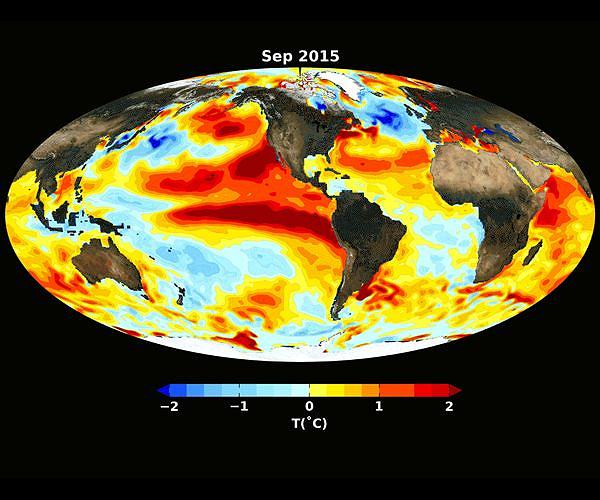
El Nino, a significant warm-water event in the tropical Pacific that influences global weather patterns, has a history that stretches back at least 250 million years, according to a new modeling study conducted by researchers at Duke University.
The study found that the oscillation between El Nino and its colder counterpart, La Nina, existed during the time when Earth's continents were in very different positions, and these temperature swings were often more intense than those we experience today. The research, published in the *Proceedings of the National Academy of Sciences*, reveals that the El Nino Southern Oscillation (ENSO) was much stronger in the distant past, sometimes significantly surpassing the intensity of modern-day events.
"In each experiment, we see active El Nino Southern Oscillation, and it's almost all stronger than what we have now, some way stronger, some slightly stronger," said Shineng Hu, an assistant professor of climate dynamics at Duke University's Nicholas School of the Environment.
The researchers used the same climate models that the Intergovernmental Panel on Climate Change (IPCC) employs to predict future climate scenarios. However, for this study, they ran the models backward to examine climate conditions as far back as 250 million years ago. To manage the massive computational effort, they simulated the climate in 10-million-year increments, conducting 26 such simulations.
The climate models incorporated various factors such as different land-sea distributions, solar radiation levels, and atmospheric CO2 concentrations. "The model experiments were influenced by different boundary conditions, like different land-sea distribution (with the continents in different places), different solar radiation, different CO2," Hu explained. Each simulation ran for thousands of model years to ensure robust results.
Hu noted that during some periods, Earth received 2% less solar radiation than today, but higher levels of CO2 made the atmosphere and oceans much warmer. For example, in the Mesozoic era, 250 million years ago, the oscillation occurred in the Panthalassic Ocean to the west of the supercontinent Pangea.
The study also highlighted two key factors influencing the historical magnitude of the oscillation: the ocean's thermal structure and "atmospheric noise" caused by surface winds. While previous studies primarily focused on ocean temperatures, this research underscores the importance of winds. "Besides ocean thermal structure, we need to pay attention to atmospheric noise as well and to understand how those winds are going to change," Hu said.
Hu compared the oscillation to a pendulum, explaining that "atmospheric noise – the winds – can act just like a random kick to this pendulum." Both the ocean's thermal properties and these random wind events played critical roles in past El Nino activity.
Understanding the history of ENSO could be crucial for predicting future climate patterns. "If we want to have a more reliable future projection, we need to understand past climates first," Hu added.
This research was supported by the National Natural Science Foundation of China and the Swedish Research Council Vetenskapsradet, with simulations performed at Peking University's High-performance Computing Platform.
Research Report:Persistently Active El Nino – Southern Oscillation Since the Mesozoic
