
 |
 |
 |
 |
 |
 |
 |
 |
 |
 |

| . |  |
. |

Paris, France (SPX) Sep 23, 2010 A new image taken with the powerful HAWK-I camera on ESO's Very Large Telescope at Paranal Observatory in Chile shows the beautiful barred spiral galaxy NGC 1365 in infrared light. NGC 1365 is a member of the Fornax cluster of galaxies, and lies about 60 million light-years from Earth. NGC 1365 is one of the best known and most studied barred spiral galaxies and is sometimes nicknamed the Great Barred Spiral Galaxy because of its strikingly perfect form, with the straight bar and two very prominent outer spiral arms. Closer to the centre there is also a second spiral structure and the whole galaxy is laced with delicate dust lanes. This galaxy is an excellent laboratory for astronomers to study how spiral galaxies form and evolve. The new infrared images from HAWK-I are less affected by the dust that obscures parts of the galaxy than images in visible light (potw1037a) and they reveal very clearly the glow from vast numbers of stars in both the bar and the spiral arms. These data were acquired to help astronomers understand the complex flow of material within the galaxy and how it affects the reservoirs of gas from which new stars can form. The huge bar disturbs the shape of the gravitational field of the galaxy and this leads to regions where gas is compressed and star formation is triggered. Many huge young star clusters trace out the main spiral arms and each contains hundreds or thousands of bright young stars that are less than ten million years old. The galaxy is too remote for single stars to be seen in this image and most of the tiny clumps visible in the picture are really star clusters. Over the whole galaxy, stars are forming at a rate of about three times the mass of our Sun per year. While the bar of the galaxy consists mainly of older stars long past their prime, many new stars are born in stellar nurseries of gas and dust in the inner spiral close to the nucleus. The bar also funnels gas and dust gravitationally into the very centre of the galaxy, where astronomers have found evidence for the presence of a super-massive black hole, well hidden among myriads of intensely bright new stars. NGC 1365, including its two huge outer spiral arms, spreads over around 200 000 light-years. Different parts of the galaxy take different times to make a full rotation around the core of the galaxy, with the outer parts of the bar completing one circuit in about 350 million years. NGC 1365 and other galaxies of its type have come to more prominence in recent years with new observations indicating that the Milky Way could also be a barred spiral galaxy. Such galaxies are quite common - two thirds of spiral galaxies are barred according to recent estimates, and studying others can help astronomers understand our own galactic home.
Share This Article With Planet Earth
Related Links ESO Stellar Chemistry, The Universe And All Within It

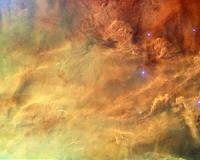 Breaking Waves In The Stellar Lagoon
Boston MA (SPX) Sep 23, 2010 A spectacular new NASA/ESA Hubble Space Telescope image reveals the heart of the Lagoon Nebula. Seen as a massive cloud of glowing dust and gas, bombarded by the energetic radiation of new stars, this placid name hides a dramatic reality. The Advanced Camera for Surveys (ACS) on the NASA/ESA Hubble Space Telescope has captured a dramatic view of gas and dust sculpted by intense radiation f ... read more |
|
|
| The content herein, unless otherwise known to be public domain, are Copyright 1995-2010 - SpaceDaily. AFP and UPI Wire Stories are copyright Agence France-Presse and United Press International. ESA Portal Reports are copyright European Space Agency. All NASA sourced material is public domain. Additional copyrights may apply in whole or part to other bona fide parties. Advertising does not imply endorsement,agreement or approval of any opinions, statements or information provided by SpaceDaily on any Web page published or hosted by SpaceDaily. Privacy Statement |


 del.icio.us
 Digg
Digg Reddit
 YahooMyWeb
 Google
 Facebook







