 |
 |
 |
 |
 |
 |
 |
 |
 |
 |

| . |  |
. |
Boeing Demonstrates Future On-Orbit Servicing Capability With Orbital Express
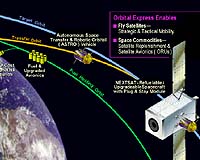
St. Louis MO (SPX) Aug 31, 2007 A four-month demonstration conducted in space of the Boeing Orbital Express system culminated in an unqualified success. The mission, sponsored and led by the Defense Advanced Research Projects Agency (DARPA) to validate on-orbit servicing technologies, tested the system from March 8 to July 2. Orbital Express met or exceeded all of its test objectives to become the world's first spacecraft capable of performing autonomous on-orbit servicing functions. With the successful demonstration of Orbital Express, Boeing has shown that it can provide satellite customers with a capability to extend spacecraft lifespan through refueling and component replacement, and offer robotic support for space operations. "Boeing has opened a new market with Orbital Express, and this capability will benefit the satellite industry as well as space exploration ventures," said Alex Lopez, vice president, Boeing Advanced Network and Space Systems. "We see a great future in providing global space customers options they've never had before." Orbital Express consists of the Autonomous Space Transport Robotic Operations (ASTRO) servicing spacecraft developed by Boeing. Ball Aerospace's NextSat served as a prototypical modular next-generation serviceable client spacecraft. The demonstration comprised eight scenarios that were performed in different lighting conditions and approaches. Mated operations included battery and fuel transfers and computer replacement. Unmated operations involved separation of the spacecraft to various ranges, far-and near-field rendezvous, proximity operations, approach, capture and mate. "The purpose of Orbital Express was to demonstrate technologies needed for satellite servicing, autonomous free flight, rendezvous and capture, and transferring fuel and components to a satellite -- and we accomplished that," said Bob Friend, Boeing Orbital Express chief engineer and program manager. The demonstration successfully validated Boeing's Autonomous Rendezvous and Capture Sensor System. The system identified NextSat more than 400 kilometers away, enabling ASTRO to approach within a few meters of NextSat while determining its exact position, attitude and best mating location. Boeing sees many applications and benefits of on-orbit servicing and proximity operations that can be accomplished by Orbital Express. In addition to spacecraft fuel and component replenishment, the open standard interfaces such as the docking and re-fueling systems enable increased value and utility for next-generation spacecraft. The advanced robotic arm can support precision robotics work, on-orbit assembly or contingency operations and can be used to move satellites into proper orbit or position satellites and space debris for safe de-orbit. Orbital Express also supports Operationally Responsive Space needs. DARPA de-commissioned Orbital Express in mid-July to conclude one of the most complex missions ever attempted in space. Orbital Express team members included NASA; Ball Aerospace; Northrop Grumman Space Technology; MacDonald, Dettwiler and Associates Ltd.; the Charles Stark Draper Laboratory Inc.; and Starsys Research. Community Email This Article Comment On This Article Related Links Orbital Express Space Technology News - Applications and Research
 Photon-Transistors For The Supercomputers Of The Future
 Copenhagen, Denmark (SPX) Aug 27, 2007
Scientist from the Niels Bohr Institute at University of Copenhagen and from Harvard University have worked out a new theory which describe how the necessary transistors for the quantum computers of the future may be created. The research has just been published in the scientific journal Nature Physics. |
|
|

| The content herein, unless otherwise known to be public domain, are Copyright 1995-2007 - SpaceDaily.AFP and UPI Wire Stories are copyright Agence France-Presse and United Press International. ESA Portal Reports are copyright European Space Agency. All NASA sourced material is public domain. Additional copyrights may apply in whole or part to other bona fide parties. Advertising does not imply endorsement,agreement or approval of any opinions, statements or information provided by SpaceDaily on any Web page published or hosted by SpaceDaily. Privacy Statement |