|
 |
 |
 |
 |
 |
 |
 |
 |
 |

| . |  |
. |
Computer Simulations Predicted Present Day Distribution of Elusive First Stars
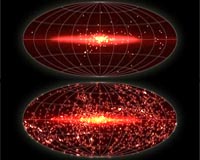
Santa Barbara CA (SPX) Dec 13, 2006 With the help of enormous computer simulations, astronomers have now shown that the first generation of stars - which have never been observed by scientists - should be distributed evenly throughout our galaxy, deepening the long-standing mystery about these missing stellar ancestors. The results are published in this week's issue of the Astrophysical Journal. The problem is that despite years of looking, no one has ever found any of these stars. "Many astronomers thought this was because the stars without heavy elements were hidden from us," said Evan Scannapieco, first author and a postdoctoral fellow at the Kavli Institute for Theoretical Physics at the University of California, Santa Barbara. "Because our galaxy formed from the inside out, the idea was that these very old stars would all be near the center. But the center of Milky Way is extremely crowded with dust and newer stars, making it very hard to detect individual old stars in this environment." This earliest generation of stars should look very different from later-forming stars like the Sun; yet so far, no one has detected a survivor from this primordial population. One of the long-standing explanations for this discrepancy was that these stars might all be contained in regions near the center of the Milky Way, where they are very hard to observe. The results of the new study make that explanation unlikely. Oxygen, carbon, and most of the elements we encounter every day on Earth were made in stars, rather than during the Big Bang. "But these heavy elements are made in the centers of stars and remain buried under the gas at the surface until the stars die and explode, so what you see when you look at a star are the elements that were present when it was born," said Brad K. Gibson, co-author and chair of the Department of Theoretical Astrophysics at the University of Central Lancashire in Britain. "This means that the stars still living from this first generation should continue to show no heavy elements." Carrying out a detailed simulation of the formation of the Milky Way, the research group constructed not only the history of where stars formed over time, but the chemical composition of the gas out of which these stars formed. "We found that while the very oldest stars all end up near the center of the Milky Way, it takes a long time for heavy elements to enrich the gas that is further out," said co-author Daisuke Kawata, a scientist with the Carnegie Observatories in Pasadena, California. "This means that while the oldest stars all end up near the center of the galaxy, plenty of stars that contain only primordial elements are formed at later times throughout the galaxy. These primordial stars should be everywhere." Because the stars forming in the Milky Way suburbs are easily detectable with present day telescopes, there must be some other reason that the remnants of this primordial generation didn't survive. "It could be that they were all high-mass stars, which would not have lived long enough to still be around, or there could be another twist to the story that we haven't yet figured out," said co-investigator Chris Brook, a scientist with the University of Washington. "Whatever the answer, it's clear that studies of the outskirts of our galaxy will have lots more to tell us about this remarkable, missing generation." Other scientists involved in the research were Andrea Ferrara of the International School for Advanced Studies in Trieste, Italy and Rafaella Schneider of the Arctri Observatory in Florence, Italy. Related Links Stellar Chemistry, The Universe And All Within It  Russia Faces Problems In Developing Space Technology
 Moscow (RIA Novosti) Dec 15, 2006
In 2007, the world will mark the 150th anniversary of the birth of Russian scientist Konstantin Tsiolkovsky, the father of astronautics and formulator of the jet propulsion theory, as well as the 50th anniversary of the Soviet Union's launch of the first space satellite in history. Consequently, all eyes will once again turn to Russia's space program. |
|
|

| The content herein, unless otherwise known to be public domain, are Copyright 1995-2006 - SpaceDaily.AFP and UPI Wire Stories are copyright Agence France-Presse and United Press International. ESA PortalReports are copyright European Space Agency. All NASA sourced material is public domain. Additionalcopyrights may apply in whole or part to other bona fide parties. Advertising does not imply endorsement,agreement or approval of any opinions, statements or information provided by SpaceDaily on any Web page published or hosted by SpaceDaily. Privacy Statement |