|
 |
 |
 |
 |
 |
 |
 |
 |
 |

| . |  |
. |
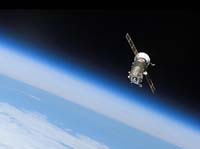
Progress To Launch To Space Station
Baikonur, Kazakhstan (SPX) Jul 31, 2007 A new Progress cargo carrier is scheduled to launch to the International Space Station at 1:34 p.m. EDT Thursday, Aug. 2, with more than 2.5 tons of fuel, air, water and other supplies and equipment aboard. The station's 26th Progress unpiloted spacecraft will bring to the orbiting laboratory almost 1,600 pounds of propellant, more than 100 pounds of air and oxygen, more than 465 pounds of water and 2,954 pounds of dry cargo. Total cargo weight is 5,111 pounds. Among the dry cargo are spares for Russian computers that had problems during the STS-117 mission of Atlantis to the station in June. P26 will launch from the Baikonur Cosmodrome in Kazakhstan. It is scheduled to dock with the station Sunday, Aug. 5, at about 2:38 p.m. The spacecraft will use the automated Kurs system to dock at the aft port of the Zvezda Service Module. Expedition 15 Commander Fyodor Yurchikhin will be at the manual TORU docking system controls, should his intervention become necessary. Once Expedition 15 crew members, Yurchikhin and flight engineers Oleg Kotov and Clay Anderson, have unloaded the cargo, P26 will be filled with trash and station discards. It will be undocked from the station with its load of trash and deorbited, to burn in the Earth's atmosphere. The Progress is similar in appearance and some design elements to the Soyuz spacecraft, which brings crew members to the station, serves as a lifeboat while they are there and returns them to Earth. The aft module, the instrumentation and propulsion module, is nearly identical. But the second of the three Progress sections is a refueling module, and the third, uppermost as the Progress sits on the launch pad, is a cargo module. On the Soyuz, the descent module, where the crew is seated on launch and which returns them to Earth, is the middle module and the third is called the orbital module. Community Email This Article Comment On This Article Related Links Space Station News at Space-Travel.Com
 Name And Designer Logo Revealed For Paolo Nespoli Shuttle Mission To The ISS
 Paris, France (ESA) Jul 27, 2007
ESA and the Italian Space Agency (ASI) announced that they have chosen the name for the upcoming mission of astronaut Paolo Nespoli, a member of the STS-120 crew assigned to a Shuttle launch next October. The mission has been dubbed Esperia from the Ancient Greek name for the Italian peninsula. The choice of name reflects how Nespoli's Shuttle mission to the International Space Station (ISS) will be a showcase for European technology, with the delivery of Italian-built Node 2. |
|
|

| The content herein, unless otherwise known to be public domain, are Copyright 1995-2007 - SpaceDaily.AFP and UPI Wire Stories are copyright Agence France-Presse and United Press International. ESA Portal Reports are copyright European Space Agency. All NASA sourced material is public domain. Additional copyrights may apply in whole or part to other bona fide parties. Advertising does not imply endorsement,agreement or approval of any opinions, statements or information provided by SpaceDaily on any Web page published or hosted by SpaceDaily. Privacy Statement |