
When audiences watched the film The Day After Tomorrow, they saw an exaggerated Hollywood depiction of abrupt climate disruption, but the underlying concept that Earth's climate can shift rapidly has a firm scientific basis. During the last Ice Age, Greenland temperatures jumped by as much as 16 degrees Celsius within decades and repeated surges of icebergs disrupted the North Atlantic, events known as Dansgaard-Oeschger and Heinrich events.
These rapid transitions, classed as millennial-scale climate events, show that Earth's climate system can reorganize much faster than the slow orbital cycles that pace long-term climate change. Until now, most explanations have linked such millennial-scale variability to the dynamics of large ice sheets, leaving open the puzzle of how similar behavior could arise during warm greenhouse periods when continental ice was absent.
An international team led by Professor Chengshan Wang at the China University of Geosciences in Beijing now proposes a solution that does not rely on ice sheets. Working with colleagues from Belgium, Austria and China, the team demonstrates that Earth's precession cycles, the slow wobbles of its rotational axis, can naturally generate abrupt millennial-scale climate fluctuations even under ice-free conditions.
The researchers anchored their work in a high-resolution record from sediment cores drilled in China's Songliao Basin, laid down about 83 million years ago in the Late Cretaceous, a classic greenhouse interval with high atmospheric carbon dioxide and no major ice sheets. These cores were obtained through the Cretaceous Continental Scientific Drilling Project, an international initiative launched in 2006 under Prof. Wang's leadership.
In astronomical terms, Earth's spin axis slowly traces a wobble like a spinning top, a motion known as axial precession that completes one full cycle in roughly 26,000 years. When this axial precession interacts with the gradual rotation of Earth's elliptical orbit, it produces two main climatic precession cycles of about 19,000 and 23,000 years that modulate how solar energy is distributed seasonally between the hemispheres.
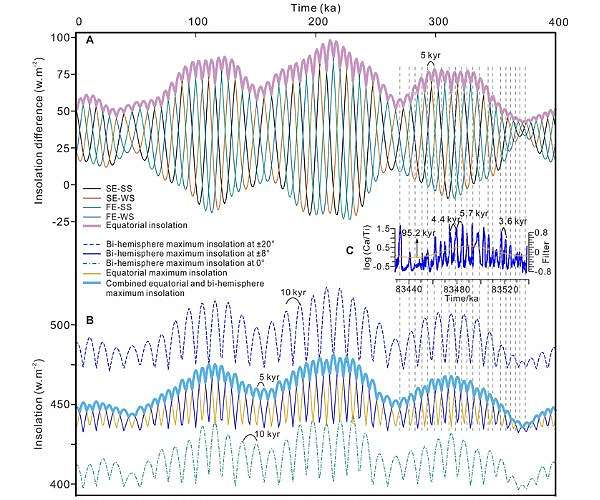
Because Earth's rotation axis is tilted relative to its orbital plane, regions outside the tropics experience a single annual peak in solar radiation, near the local summer solstice. By contrast, tropical latitudes see two annual maxima in solar radiation near the equinoxes and two minima near the solstices, creating a distinct double-maximum pattern in daily insolation.
This geometry means that in the tropics, the contrast in solar radiation between seasons shows four peaks within a single year. Over the course of a full precession cycle, that structure yields four distinct climatic responses to precession-driven insolation forcing and produces a characteristic quarter-precession periodicity of around 5,000 years.
The new Songliao Basin record supports this theoretical picture. By integrating geochemical data, mineralogical indicators and bioturbation simulations, the team reconstructed Late Cretaceous climates that alternated between humid and arid states with strong 4,000 to 5,000 year periodicities superimposed on longer trends.
The amplitude of these humid-arid oscillations was not constant but waxed and waned in step with cycles of roughly 100,000 years, which correspond to variations in Earth's orbital eccentricity. This pattern indicates that eccentricity acted as a modulator, strengthening or weakening the imprint of precession on climate over time.
According to the authors, the reconstructed Cretaceous climate cycles match the expected theoretical pattern of equatorial insolation response to precession. The close fit suggests that variations in equatorial insolation alone can exert a powerful influence on global climate, helping to spontaneously trigger millennial-scale cycles without requiring feedbacks from large ice sheets.
Spectral analyses of the proxy records further show that the approximately 5,000-year insolation cycles can, through nonlinear climate processes, generate even faster swings lasting from about 1,800 to 4,000 years. These faster variations may represent internal reorganizations of the climate system responding to the regular precession forcing.
Taken together, the Late Cretaceous reconstructions and the theoretical calculations indicate that even under warm, ice-free conditions Earth's climate was far from stable. Instead, it repeatedly oscillated between arid and humid regimes, with precession-related changes in solar forcing acting as the primary pacemaker.
"During the Late Cretaceous, atmospheric CO2 levels reached about 1,000 parts per million, comparable to projections for the end of this century," says Prof. Michael Wagreich, a paleoclimatologist at the University of Vienna. "This makes the Cretaceous greenhouse climate a meaningful analogue for understanding Earth's future."
"Because Earth's orbital configuration will remain stable for billions of years, the unveiled close link we identified between astronomical precession and millennial-scale climate cycles implies that high-frequency climate oscillations, like those seen in the Cretaceous, could also emerge in a warmer future, potentially in ways that are more predictable than previously thought," says first author Zhifeng Zhang.
Research Report:Precession-induced millennial climate cycles in greenhouse Cretaceous
